“The lenders invoked the market disruption clause,” said Edmund Ding, Hon Hai spokesman. “This happened because global interbank lending rates spiked following Lehman’s breakdown just as our loans were being rolled over.” Mr Ding said the uncertainties were likely to force companies to adjust the way they borrow.
Most loan financings carry a “market disruption clause”, which allows lenders to switch the rate at which they lend to a company from a Libor-based price to a level that represents their true cost of funds. Depending on the deal, it requires the approval of at least a third of the syndicate and also requires banks to disclose what they believe their own cost of funding to be – something they have hitherto been reluctant to do.
A potential headache for banks is that many such facilities will have been agreed before the recent worsening in credit conditions at a fixed rate over Libor – a rate that may now be lower than a bank’s all-in cost of funding that facility. Before triggering such clauses banks have to weigh the risk of upsetting clients that may take business elsewhere.
Tuesday, September 30, 2008
Rising cost of borrowing
The FT looks at the way that the disruption to bank funding costs is increasing the cost of borrowing for large firms.


Thursday, September 25, 2008
Buffett on leverage
William Buffett on de-deverage (ht Paul Kedrosky).
What you have, Joe {Kernen], you have all the major institutions in the world trying to deleverage. And we want them to deleverage, but they're trying to deleverage at the same time. Well, if huge institutions are trying to deleverage, you need someone in the world that's willing to leverage up. And there's no one that can leverage up except the United States government. And what they're talking about is leveraging up to the tune of 700 billion, to in effect, offset the deleveraging that's going on through all the financial institutions. And I might add, if they do it right, and I think they will do it reasonably right, they won't do it perfectly right, I think they'll make a lot of money.
Wednesday, September 24, 2008
Bias
The availability heuristic, giving undue weight to evidence that is easily available, makes it more likely that people focus on what has happened recently. This can be added to the technical things like 'noise trader risk' to explain some of the short term bubble creation.
Peter McCluskey
Peter McCluskey
People who carefully looked for and evaluated as much relevant evidence as they could saw some chance of the current panic happening, regardless of whether they used intuition or fancy statistical models. Some of them warned of the risk. But it was hard for most people to worry about warnings that had been consistently wrong under all the conditions that were fresh in their minds.
Resisting peer pressure isn't pleasant. The banker who insisted on a 20% down payment for all mortgages got less business during the bubble and was seen by his colleagues as a burden on the bank and an obstacle to helping customers. The regulator who insisted on a 20% down payment for all mortgages was seen as denying the poor the good investments that were available to the rest of the country, and as an obstacle to home ownership (sometimes better described as home borrowing)(governments think home ownership ought to be encouraged, in spite of (or because of?) its tendency to increase unemployment).
Tuesday, September 23, 2008
Credit crunch
John Jansen highlights the increase in the cost of borrowing for Caterpillar.
This does suggest some ugly contraction to come.
In early August Caterpillar brought a 5 year bond to market, the 4.90 of August 2013. That bond priced 175 basis points cheap to the benchmark 5 year Treasury note. With the turmoil in the credit markets the last several weeks, the issue has widened on spread and this morning it was quoted 225/ 210.
The talk on the new issue is T + 325 basis points. That is fully 100 basis points cheap to the outstanding issue and 150 basis points above where the same maturity was priced six weeks ago.
This is very disturbing because Caterpillar is an industrial company, unsullied by association with the credit crunch. If it takes that much concession to sell a solid stable industrial, what might the outcome be when a large financial seeks to tap the market.
This does suggest some ugly contraction to come.
Friday, September 19, 2008
Tuesday, September 16, 2008
Risk-adjusted returns
The FT
The message delivered to shocked Lehman Brothers staff on Monday was simple and direct. “It’s over,” announced Christian Meissner to a morning staff gathering just a week after being appointed to run Lehman’s Europe business. He told the staff to look for new work and “move on”. In Lehman’s offices around the globe, staff had little choice but to follow suit as they came to terms with the collapse of the 158-year-old institution, leaving workplaces with belongings hastily collected and their savings depleted. The mantra of Lehman Brothers was to pay its staff in stock – some 30% of the bank’s equity was held by employees and many bonuses were paid in shares. Now those holdings are all but worthless. Some staff were also told not to expect this month’s paycheck and that they might even be liable for expenses on their corporate credit cards. Others said they had been banned from sending emails and that BlackBerrys and mobile phones no longer worked. Some of Lehman’s senior bankers are expected to set up independent advisory boutiques in the near future.
Saturday, September 13, 2008
OIS
Willem Buiter looks at the endgame in the banking system.
[i] The OIS rate is the fixed leg of a swap whose variable counterpart is the daily compounded return of some safe or secured benchmark rate on overnight transactions. Typically, the overnight benchmark is the weighted average of the central bank rate. In the US this would be the Federal Funds Effective rate. In the UK it is SONIA, in the euro area EONIA. Libor is the benchmark rate supposed to representative of the interest rates at which banks offer to lend unsecured funds to each other in the London wholesale money market (or interbank market).
Sunday, September 07, 2008
Income elasticity of demand
The slowdown is having some impact on the demand for organic produce. The FT notes that households are trading down.
According to TNS sales data, sales of organic fruit and vegetables increased just 2 per cent in the year to August - a dramatic slowdown from the double-digit increases previously enjoyed. Sales of organic eggs have declined every month this year and now account for 4.7 per cent of the market, against 7.4 per cent at its peak.
Friday, September 05, 2008
Exchange rate forecasing
Jian Wang at Voxeu looks at the asset-price approach to exchange rate forecasting. This essentially says that exchange rates are based on forecasts of future fundamentals. Present fundamentals have a minor role. Future fundamentals are unknown. Therefore, they may not be any use in forecasting, but they would allow for some relationship between fundamentals and exchange rates.
This can also be related to the idea that portfolio flows respond to future fundamentals.
This can also be related to the idea that portfolio flows respond to future fundamentals.
Engel and West (2005) argue that the exchange rate disconnect is consistent with exchange rates being determined by fundamental variables. They show that existing exchange rate models can be written in a present-value asset-pricing format. In these models, exchange rates are determined not only by current fundamentals but also by expectations of what the fundamentals will be in the future. Current fundamentals receive very little weight in determining the exchange rate. Not surprisingly, they aren’t useful in forecasting.
Under the Engel-West explanation, judging exchange rate models by their ability to forecast is too harsh a standard: If exchange rates are determined by fundamentals in the same way as other asset prices, current fundamentals can’t forecast exchange rates better than a random walk, even if the asset-pricing model correctly captures the relation between economic fundamentals and exchange rates. In this case, fundamental-based models are still appropriate for economic analysis, such as exchange rate and trade policy analysis – they are just useless in forecasting.
How do we know the asset-pricing model is applicable? Are there other ways to test fundamental-based exchange rate models if beating the random walk in forecasting exchange rates is too harsh? While the asset-pricing approach doesn’t allow us to predict short-term exchange rates, it does lead to an interesting implication. If the exchange rate is determined by expected future fundamentals, today’s currency values should contain information about tomorrow’s fundamentals.
Thursday, September 04, 2008
Fund strategy
One of ideas of corporate strategy is to position the firm and make sure all the components of the business are pushing in the same direction. A simplified version of this says that the firm should seek high price and high value or low price and relatively low value.
The FT look at research from Morgan Stanley that suggests that the asset management business is becoming increasingly polarised into tracker funds and hedge funds.
So it’s “cheap or spicy” - and the main driver continues to be performance versus cost.
Huw van Steenis and his team at Morgan Stanley this week published an 80 page update on the European asset management industry, noting the continuing deterioration in the outlook for traditional managers and at the same time an accelerating rationalisation of alternative managers as winners and losers in the hedge space diverge.
The top 100 hedge funds now represent 69 per cent of total hedge fund assets, up from 56 per cent in 2006, according to Mr van Steenis. The analyst sees “massive” rotation between winners and losers in the sector after the years of plenty.
Monday, September 01, 2008
The evolution of European exchanges
The FT has an excellent overview of the competition for market share in the European equity arena. New regulations and a shift in the business plan are creating opportunities.
Estelle Cantillon and Pai-Ling Yin look at the migration of the bund future from LIFFE to the DTB and assess the risk of new financial tipping points.
Estelle Cantillon and Pai-Ling Yin look at the migration of the bund future from LIFFE to the DTB and assess the risk of new financial tipping points.
Sunday, August 31, 2008
UK SME financing
The University of Cambridge Centre for Business Research has a survey of UK SME financing for 2007.
The survey of businesses with less than 250 employees was carried out in the autumn of 2007, but is unlikely to have captured the full consequences of the credit crunch and slowing economy. It shows that there has been a decline in the use of external finance from 81% of firms in 2004 to 69% in 2007. However, the majority of firms said that there had been no change in the ease of obtaining finance and 71% of those seeking new finance received all that they sought. The report examines these headline figures across firm sizes, regions and industrial sectors. It also includes special chapters on key topics such as female-led businesses, start-up businesses, super growth businesses and those in deprived areas.
Real appreciation
Karolina Ekholm, Andreas Moxnes and Karen-Helene Ullveit-Moe look at the effect of the 17% real appreciation of the Norwegian Krone in the 2000 to 2001 period. Using micro data of the performance of Nowegian firms, they find three things:
This gives some insight into the costs of the Dutch disease.
Michael Veseth looks at the affect of US dollar depreciation on the US wine industry.
First, the real exchange rate shock was associated with substantial employment losses. One-seventh of the total decline in manufacturing employment over the period under study can be attributed to the real appreciation.
Second, the shock led to productivity gains at the firm level, indicating that the most exposed firms were able to improve efficiency in a period of tougher foreign market conditions. One-fifth of the productivity improvement over the same time span can also be attributed to the real appreciation. Somewhat surprisingly, we do not find evidence of market reallocation effects; the real appreciation does not seem to have been associated with a reallocation of resources from low-productivity to high-productivity firms.
Third, firms responded to the real appreciation by offshoring (Ekholm and Ulltveit-Moe 2007), thereby purchasing a larger share of their intermediate inputs from abroad. For the manufacturing industry as a whole, the real appreciation increased the import share of intermediates by about 1.5%
This gives some insight into the costs of the Dutch disease.
Michael Veseth looks at the affect of US dollar depreciation on the US wine industry.
Saturday, August 30, 2008
Asymmetric risk
The FT reports Merrill Lynch having lost a quarter of its profits for the 36 year period as a listed company in the space of 18 months.
This is a similar performance to that of hedge funds that find a skewed distribution for their returns. There are steady profits in return for taking asymmetric risk. This is also linked to the short-term nature of governance and incentives.
This is a similar performance to that of hedge funds that find a skewed distribution for their returns. There are steady profits in return for taking asymmetric risk. This is also linked to the short-term nature of governance and incentives.
Saturday, August 23, 2008
Diamonds are forever
The Atlantic looks at the history of the diamond. The main focus is marketing and the preparation of the market. However, there is also a lot of interesting information about the control of pricing even in the face of adversity.
Here are some diamond prices from Swivel, an end of 2007 cross section rather than time series.
Here are some diamond prices from Swivel, an end of 2007 cross section rather than time series.
Monday, August 18, 2008
New technology
How do business deal with new technology that threatens to provide an alternative product?
Economic Principals looks at the way that the newspaper industry has to adapt.
The example of the radio and television can provide some insight. Radio has its own strength. It is particularly powerful when you cannot watch a picture because you are doing something else. The strength of the newspaper is that it can be passed around. In some ways it is much easier to find things. The newspapers have the advantage of having good, clear links to the sources of information. That have reputation.
Economic Principals looks at the way that the newspaper industry has to adapt.
Those enormous rolls of newsprint, tank-cars of ink, long lines of presses and fleets of delivery vans are the newspaper industry’s best friends. Among business strategists, they are known as barriers to entry. The capacity to print and deliver the paper product from cities around the world is what makes newspapers different from everything and everyone else in this media-sodden world. Precisely from all this impedimenta – and the paper product it produces – does the authority of newspapers’ increasingly extensive Web-based operations derive.
The example of the radio and television can provide some insight. Radio has its own strength. It is particularly powerful when you cannot watch a picture because you are doing something else. The strength of the newspaper is that it can be passed around. In some ways it is much easier to find things. The newspapers have the advantage of having good, clear links to the sources of information. That have reputation.
Wednesday, August 13, 2008
More on the commons
More on the tragedy of the commons and how it is being use today to tackle problems.
Monday, August 11, 2008
Soft skills
Richard Reeves looks at the importance of soft skills in the labour market and the way that they contribute to inequality.
There is also a BBC Analysis programe here.
This fits well with the argument from Chris Dillow that self-esteem is associated with higher earnings. It is also consistent with his idea that we can see the world as a zero-sum or positive sum. If our circumstances, lack of resources and limited opportunity reinforce the zero-sum view of the world, this would tend to undermine our ability to get a better job; if our circumstances support a positive-sum view of the world with benefits from co-operation, trust and thrift, this will encourage this the behaviour that is more rewarded in regualar society - particularly the labour market.
Recent claims about social mobility in Britain grinding to a halt are exaggerated. But it does seem that the likelihood of a person being upwardly mobile is increasingly influenced by personal qualities such as confidence and self-control. Julia Margo, associate director of the Institute for Public Policy Research, has assembled an impressive body of evidence linking character to life chances. Her work, which draws on that by Leon Feinstein at the Institute of Education, shows that measured levels of "application"—defined as dedication and a capacity for concentration—at the age of ten have a bigger impact on earnings by the age of 30 than ability in maths. Similarly, what psychologists call an "internal locus of control"—a sense of personal agency—at the age of ten has a bigger impact than reading ability on earnings.
There is also a BBC Analysis programe here.
This fits well with the argument from Chris Dillow that self-esteem is associated with higher earnings. It is also consistent with his idea that we can see the world as a zero-sum or positive sum. If our circumstances, lack of resources and limited opportunity reinforce the zero-sum view of the world, this would tend to undermine our ability to get a better job; if our circumstances support a positive-sum view of the world with benefits from co-operation, trust and thrift, this will encourage this the behaviour that is more rewarded in regualar society - particularly the labour market.
Sunday, August 10, 2008
Valuation
The Economist looks at valuation and returns on asset classes in the long-run.
This is roughly how GMO goes about the process: it looks at the relationship between valuations and long-term returns. The return from equities, for example, is equal to the existing dividend yield, plus future dividend growth, plus or minus changes in valuations. Ten years ago, the dividend yield on the American market was low while valuations were high. The likely long-term return looked low, and so it has proved.
Using similar reasoning, GMO has a very gloomy outlook for the American and British housing markets at the moment. By using the ratio of the median house price to the median family income, GMO reckons that prices in America need to fall by 17% instantly or stay flat for four years to return value. In Britain, prices need to fall by 38% or stay flat for seven years. And of course, there is no guarantee they will stay at fair value; in the mid-1990s, they dropped well below it.
Friday, August 08, 2008
The end of an era
The FT reports.
This is a trader's comment after the 1987 crash. It may be significant that this are the words of a trader. What is heard more often today are the words of Joe Public and the government. However, as the report points out, the fear of computerised trading has dissipated since 1987. Futures markets, which were used for Portfolio Insurance, are now mundane.
We’re observing the end of an era in two very specific areas. First is the uncontrolled deregulation of global financial markets ... The second point is, the mindless commitment of human and financial resources to securitisation has reached its peak and now will contract for the indefinite future.
This is a trader's comment after the 1987 crash. It may be significant that this are the words of a trader. What is heard more often today are the words of Joe Public and the government. However, as the report points out, the fear of computerised trading has dissipated since 1987. Futures markets, which were used for Portfolio Insurance, are now mundane.
Risk management
A great overview from The Economist
Good coverage of some of the institutional issues as well as the limbo position of credit derivatives, standing somewhere between the trading desk and the credit desk and never gaining full attention.
There is a a reaffirmation of the way that banks sold the lower tranches and maintained the higher tranches for themselves, The position gradually increased as it thought inconceivable that these 'safe' assets could lose much value because of credit or market changes.
Last but not least, change the perception and standing of risk departments by giving them more prominence. The best way would be to encourage more traders to become risk managers. Unfortunately the trend has been in reverse; good risk managers end up in the front-line and good traders and bankers, once in the front-line, very rarely go the other way. Risk managers need to be perceived like good goalkeepers: always in the game and occasionally absolutely at the heart of it, like in a penalty shoot-out.
Good coverage of some of the institutional issues as well as the limbo position of credit derivatives, standing somewhere between the trading desk and the credit desk and never gaining full attention.
There is a a reaffirmation of the way that banks sold the lower tranches and maintained the higher tranches for themselves, The position gradually increased as it thought inconceivable that these 'safe' assets could lose much value because of credit or market changes.
Thursday, August 07, 2008
Fans vs professionals
From the Guardian an analysis of odds offered by bookmakers for football in the last three years shows that betting on the top 10 in the league makes money while betting on the bottom 10 loses money. Do the gamblers and fans need to be enticed to bet for winners while fans will bet for their underdog losers even if the odds fail to provide compensation for the risk?
The Carry Trade
Gillian Tett
Most notably, because super-senior debt carried the triple-A tag, banks were only required to post a wafer-thin sliver of capital against these assets - even though this debt has typically offered a spread of about 10 basis points over risk-free funds. Thus, banks such as UBS and Merrill have been cramming their books with tens of billions of super-senior debt - and then booking the spread as a seemingly never-ending source of easy profit. It is not just the CDO desks that have been playing this game; treasury departments have been playing along. So have many hedge funds, including those financed by . . . er . . . the major investment banks.
Tuesday, August 05, 2008
Swimming naked...
A reminder from Lex that there are opportunities in a downturn.
The number of companies under offer, as reported by the Takeover Panel, is up 20% on the same period last year.
The number of companies under offer, as reported by the Takeover Panel, is up 20% on the same period last year.
Monday, August 04, 2008
US overseas income
Returning to US overseas income. Alexander Hijzen looks at FDI and the effect on local wages.
It is probably the case that the full productivity is not reflected in wages. The pull from low level of local wages probably ensure that some of the productivity improvement is taken by the (possibly US-owned) MNE. However, it is much harder to achieve this in the competitive US market.
Do foreign multinationals pay higher wages than domestic firms? Simple comparisons suggest they do. Moreover, wage differences between MNEs and local firms tend to be larger in developing countries, presumably reflecting the larger productivity advantage MNEs over local firms in those countries. Simple comparisons between MNEs and local firms, however, overstate the contribution of FDI to improving pay, because FDI is typically concentrated in the most advanced sectors and largest firms in the host economy, which would pay above-average wages even if they were locally owned. Even after correcting for this bias, it is still the case that MNEs offer better pay than domestic firms, particularly in developing countries where their productivity advantage is greatest.
It is probably the case that the full productivity is not reflected in wages. The pull from low level of local wages probably ensure that some of the productivity improvement is taken by the (possibly US-owned) MNE. However, it is much harder to achieve this in the competitive US market.
Saturday, August 02, 2008
Tragedy of the commons
A very good overview of the issues from The Economist
It is not simply that three-quarters of those living on less than $2 a day still depend in some way on commonly held resources. The concept of the commons is also spreading to new areas. Their essential feature is that they share one characteristic with private property and one with public goods. Like public goods, they are not “excludable”: the common resource is too extensive to keep people out very easily. But they are also “subtractable” (or “rivalrous”), like private property: if one person uses them, another’s access is diminished. (With a classic public good, such as street lighting, one person’s usage does not affect anyone else.) Many things other than rainforests or drylands share these attributes.
The important point for new areas like climate change is that tragedy is not innevitable.
It is not simply that three-quarters of those living on less than $2 a day still depend in some way on commonly held resources. The concept of the commons is also spreading to new areas. Their essential feature is that they share one characteristic with private property and one with public goods. Like public goods, they are not “excludable”: the common resource is too extensive to keep people out very easily. But they are also “subtractable” (or “rivalrous”), like private property: if one person uses them, another’s access is diminished. (With a classic public good, such as street lighting, one person’s usage does not affect anyone else.) Many things other than rainforests or drylands share these attributes.
The important point for new areas like climate change is that tragedy is not innevitable.
Wednesday, July 30, 2008
Overseas income
There is a lot of information about the financing of the US external deficit. AS part of this is clearly due to financing in low yield reserve currency which is in demand because of its liquidity. However, as Gournichas and Rey show in From World Banker to World Venture Capitalist: US External Adjustment and the Exhorbitant Priveledge this is also about the returns that are achieved on the same assets. US FDI returns are much in excess of the returns that foreigners achieve in the US. HBS Working Knowledge suggest that this is partly because of the tough condtions that exist in the US. There is no low hanging fruit.
Another reason that financing the US deficit may be easier than had been feared is that sovereign wealth funds should probably not be seen as 'smart money'. These, after all, are government departments. Jory, Perry and Hemphill find that SWF investments announcements have not noticable effect on the price of the stock that they have bought and that, in the long run (for what it is worth in these cases) they have under=performed the overall stocks and the financial sector.
Another reason that financing the US deficit may be easier than had been feared is that sovereign wealth funds should probably not be seen as 'smart money'. These, after all, are government departments. Jory, Perry and Hemphill find that SWF investments announcements have not noticable effect on the price of the stock that they have bought and that, in the long run (for what it is worth in these cases) they have under=performed the overall stocks and the financial sector.
Tuesday, July 29, 2008
Viscious cycle
Yves Smith looks at the downward momentum that builds as a a firesale of assets leads to additional deterioration of balance sheet of other financial institutions.
NAB and the Australian stockmarkets were directly affected by the Merrills move, which reflects the US banker's desperate desire to quit as much of its toxic subprime mortgage related investments as it can, without regard to the flow on impact to other banks and markets.
In effect Merrill's move to sell these holdings of CDOs to a distressed debt fund investor, forced the NAB to write-down the value of its holding in the CDOs, a move which triggered a huge sell-off of Australian bank shares Friday and yesterday. Yesterday the ANZ revealed a completely unrelated set of write-offs and provisions, butr these had more to do with the slowing Australian economy.
Sunday, July 27, 2008
Behavioural finance
Scientific American looks at at decision-making and the interaction between intuition and reason.
Tuesday, July 22, 2008
Selling Louisiana back to the EU
MacroMan discusses selling Louisiana back to the EU.
The first port of call is to take profit on a number of 18th century transactions conducted by the US Government. Top of the list is the Louisiana Purchase, which was consummated in 1803 for the princely sum of $23,213,568. To derive a current marketable value, Macro Man calculates an annual cash flow by multiplying state GDPs by 18% (the proportion of US nominal GDP that the Federal government receives in tax revenue) and assigns a modest P/E multiple of 8 to the result. Perhaps some banks or Donald Trump would assign a higher multiple to these one-of-a-kind assets, but Macro Man prefers to dwell in the realm of reality.
Monday, July 21, 2008
Dublin
Some comments in the FT about Dublin as a financial center.
Dublin has effectively come from nowhere to become a strong challenger to Luxembourg as Europe’s biggest asset servicing centre. It has done this by becoming the home of choice for many Ucits funds, Europe’s leading domicile for money market funds and the largest administration centre for exchange traded funds in Europe. According to the Global Financial Centre’s Index published by the City of London, Dublin is the world’s 13th best financial centre and 10th for fund management
So how has this been achieved in the 21 years of the IFSC’s existence? A number of positive factors have fuelled Dublin’s growth, notably Ireland’s position as a member of both the European Union and the eurozone, its use of English, the strong supply of well-educated graduates (at least until recently) and the country’s legal framework.
However, regulation and tax were probably more critical to the IFSC’s success than anything. The financial regulator, the Irish Financial Services Regulatory Authority, is seen as combining robustness with responsiveness, and industry players welcome the efficiency of the regulatory approval process. The IFSRA can afford to be accommodating and attuned to innovations partly because of the lack of a significant indigenous fund management sector. Mr Slattery says: “Here in Ireland we understand the benefit of having an appropriately pitched regulatory regime.”
Low taxes have also played a big part in Dublin’s success. From the IFSC’s launch in 1987 until 2004-05, firms based there paid corporation tax at just 10 per cent. Although this has now risen to the standard 12.5 per cent, it still compares favourably with the 28 per cent levied in the UK and the EU average of 33 per cent
Sunday, July 20, 2008
Supply and demand on land prices
FT.com / In depth - US builders forced to sell off holdings: The FT looks at the combined effect of oil and food price increase on the demand for land.
"The result is that farmland close to cities that has often been the seedbed for new housing developments is becoming less valuable to builders, at the same time as farmers want more of it."
Thursday, July 17, 2008
Brad DeLong on Greenspan
Back in the second half of the 1990s, various people went into Alan Greenspan's office. "Raise interest rates!" they said. "Let unemployment go up! The Phillips curve can't have shifted in this far! The natural rate of unemployment can't have fallen so far so fast! These stock market valuations can't be rational! We are headed for a big crash, or a big inflationary spiral--unless you change course now!"Link
Alan Greenspan responded that there was no sign of overly-tight labor demand, no sign of accelerating demand-pull or wage-push inflation that would warrant interest rate increases. People were indeed investing enthusiastically in high-tech start-ups and those buying stocks at outsized price-earnings ratios. But the people doing the buying and investing were relatively well-off, and were grownups. If it turned out to be a serious bubble, and if the unwinding of the bubble triggered a financial panic and threatened to produce a high-unemployment recession, then would be the moment for the Federal Reserve to step in and clean up the mess. In the meanwhile, it would be a shame to destroy millions of jobs and wreck a period of 4%+ economic growth just because the Federal Reserve thought that it knew better than grownup investors what prices they should be paying for stocks and shares in high-tech startups, and feared that there might be trouble in the future.
Similarly, in the middle years of the decade of the 2000s, various people went into Alan Greenspan's office. "Raise interest rates!" they said. "Let unemployment go up! Long-term interest rates cannot stay this low for long! The sustainable pace of construction can't have risen so far so fast! These real estate valuations can't be rational! We are headed for a big crash, or a big inflationary spiral--unless you change course now!"
Alan Greenspan responded that there was no sign of overly-tight labor demand, no sign of accelerating demand-pull or wage-push inflation that would warrant interest rate increases. People were indeed building houses and buying mortgages and taking out home-equity loans enthusiastically at outsized price-rental and mortgage-value income ratios. But the people doing the buying and investing were relatively well-off, and were grownups. If it turned out to be a serious bubble, and if the unwinding of the bubble triggered a financial panic and threatened to produce a high-unemployment recession, then would be the moment for the Federal Reserve to step in and clean up the mess. In the meanwhile, it would be a shame to destroy millions of jobs and wreck a period of 3%+ economic growth just because the Federal Reserve thought that it knew better than grownup investors what prices they should be paying for mortgages and houses, and feared that there might be trouble in the future.
The unwinding of the dot-com bubble in 2000-2002 went remarkably well: no significant macroeconomic distress, and less financial panic and distress than I believed possible. The unwinding of the real estate bubble in 2007-2009 is so far not going well. There is, by contrast, more financial distress than I believed possible. Who thought that quantitatively sophisticated hedge funds would have enormous unhedged exposure to subprime risk? Who would have thought that highly-leveraged investment banks with an originat-and-sell business model would keep lots of the securities they had originated in their own portfolios--and kept them because they were high yield for their rating, i.e., because the market did not believe they were as low risk as the investment banks had bamboozled the ratings agencies into claiming? Who would have thought that those buying subprime mortgage securities from the likes of Countrywide had done no investigation into how Countrywide was screening out borrowers?
But so far--look: In the dot-com boom of the 1990s we were the winners. The rich investors of America built out a huge amount of fiber-optic cables and conducted an enormous amount of experimentation in business models from which we all benefit. In the real-estate boom of 2000s the rich investors of America and the world built an extra four million houses and loaned the rest of us money at remarkably low interest rates for five years. Those who moved into newly-built houses with teaser-rate mortgages wish those teaser rates would continue--but they won't, and in the meantime they got to live in a nice house for quite a low rent. Those of us who took out big home equity loans wish the low interest rates would continue--but they won't. And those of us who felt rich because our house values have appreciated wish we still could think of ourselves as sleeping on a pile of gold--but we can't.
The dot-com bubble and the real-estate bubble were bad news for the investors in Webvan, WorldCom, Countrywide, FNMA, and securitized subprime mortgages. But they were, by and large, good news for the rest of us. And investors are supposed to take care of themselves.
Now we are not yet out of the woods. If the tide of financial distress sweeps the Fed and the Treasury away--if we find ourselves in a financial-meltdown world where unemployment or inflation kisses 10%--then I will unhappily concede, and say that Greenspanism was a mistake. But so far the real economy in which people make stuff and other people buy it has been remarkably well insulated from panic at 57th and Park and on Canary Wharf.
Wednesday, July 16, 2008
Fannie Mae and the limits of public obligation
Fannie Mae and the limits of public obligation:
John Kay looks at the regulation of the financial services industry. Despite his plea, it looks much more likely that it will be the former rather than the latter.
"The problem is that the difference between government powers and government responsibility can be addressed by increasing the powers or reducing the responsibility. We should do the latter."
John Kay looks at the regulation of the financial services industry. Despite his plea, it looks much more likely that it will be the former rather than the latter.
Tuesday, July 15, 2008
The Peso Problem
Alex Tabarrok points us to an overview of the classic Peso Problem
Tabarrok also considers this to be a feature of the spread between GSE bond rates and that of other mortgage-backed securities.
More here.
Milton Friedman stated that the interest differential between the two countries may have been due to the market expecting the peso to be devalued against the US dollar. And sure enough, in 1976, the market expectation actually came true as the peso was allowed to ``float'' against the dollar.
Tabarrok also considers this to be a feature of the spread between GSE bond rates and that of other mortgage-backed securities.
More here.
Tuesday, July 08, 2008
Speculation
There are no onion futures but volatility remains high.
The onion conundrum: no futures market, high volatility - Jun. 27, 2008:
Thanks to Marginal Revolution.
The onion conundrum: no futures market, high volatility - Jun. 27, 2008:
"And yet even with no traders to blame, the volatility in onion prices makes the swings in oil and corn look tame, reinforcing academics' belief that futures trading diminishes extreme price swings. Since 2006, oil prices have risen 100%, and corn is up 300%. But onion prices soared 400% between October 2006 and April 2007, when weather reduced crops, according to the U.S. Department of Agriculture, only to crash 96% by March 2008 on overproduction and then rebound 300% by this past April"
Thanks to Marginal Revolution.
Saturday, June 28, 2008
American imports
From Freakonomics, import genius records all the container imports into the US. Scroll to the bottom of the page to watch imports in real time.
Tuesday, June 24, 2008
Efficient market
Wired in a more general look at data, uncovers a way to make more accurate predictions of crop growth. Here is a small case study in the increased efficiency of information assimilation.
Farmer's Almanac is finally obsolete. Last October, agricultural consultancy Lanworth not only correctly projected that the US Department of Agriculture had overestimated the nation's corn crop, it nailed the margin: roughly 200 million bushels. That's just 1.5 percent fewer kernels but still a significant shortfall for tight markets, causing a 13 percent price hike and jitters in the emerging ethanol industry.
Wednesday, June 18, 2008
Apple and profit
Oren Hurvitz looks at Apple and the effect of paying engineers less than the competition.
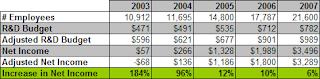
As one of the commentators says

As one of the commentators says
Working conditions at the newspaper are fine: Co-workers are pleasant, the supervisors treat me well, and I believe that both respect me. This means that my total benefits — some I certainly provided to myself — work into the equation to produce the sum total of benefits. I am conscious that I am taking advantage of them and appreciate them. I am currently satisfied with the quality and quantity that makes up the sum total. Perhaps for similar practical and intrinsic reasons, Apple employees are satisfied at Apple.
Tuesday, June 17, 2008
iPhone and price discrimination
The Telegraph looks at the iPhone and emphasises the low price of the latest model. This is another reminder of the way that Apple has successfully managed to satisfy two major segments of the market.
"Apple seems to have realised it needs to drive volumes beyond gadget-happy geeks who would pay enormous amounts to have this piece of gadget bling."
Wednesday, May 28, 2008
How Thinking Costs You
Michael S Rosenwald gives an overview of behavioural bias as he looks at how Thinking Costs You:
"Like most things human, it depends on which one you ask. Odean said he saw two options: Be dumb and let others make money off you, or just buy a no-load index mutual fund and stop focusing on beating the market. Kahneman said there was no one-size-fits-all advice, but he liked the idea of having one sure thing and one long shot. The personal finance planners say investors should stick with them -- they get paid to understand this stuff, and to win. Of course, they are humans too, which means they could be prone to the same problematic behaviors"
Sunday, May 25, 2008
Collective price discrimination
The FT looks at the possible competition case against banks charging for loan protection.
Looks like a case of price discrimination. Those that will stand up to the hard-sale ("what if you lose your job?" etc) will get the cheap loan, others pay up.
One banker said: “Personal loan rates have been uneconomic for a while. Rates are likely to go up if PPI is sold separately.”
Bankers expect the commission to argue in its provisional investigation findings – due to be published early next month – that PPI is uncompetitive because customers typically buy it only from the bank where they took out the loan.
Despite industry lobbying, the commission will stick close to its provisional conclusion this year that banks selling the insurance are earning as much as £1.5bn a year above a reasonable rate of return by selling to buyers who are in effect a captive market.
The market for PPI – which covers loan-holders if they become ill or lose their jobs – is worth about £5.5bn a year. The Office of Fair Trading said last year that banks were loading cheap loans with expensive insurance policies.
One competition lawyer who acts for a bank said the commission had concluded that banks were in effect “getting people through the door, quoting them a very low price [for a loan] then selling them something else”.
Looks like a case of price discrimination. Those that will stand up to the hard-sale ("what if you lose your job?" etc) will get the cheap loan, others pay up.
Friday, May 23, 2008
American Idol
Freakonomics: look at the ways that voting on American Idol can be predicted. There is a lot here about information and the way that it can be used in trading.
"But there are many other ways to predict who would win. TiVo has experimented with using data from 20,000 random anonymous subscribers to find out when viewers fast-forward or re-watch particular contestants. Neat idea, but so far they have had a much lower success rate than DialIdol.Instead of looking at phone and television behavior, you can also try to make predictions from Internet behavior. Apple might look at iTunes downloads of the contestant songs. Or you could use Google Trends to see which contestant name has been searched more often. David Cook rules by this method as well:"
Monday, May 19, 2008
Scarcity of safe assets
Richard Kline looks at the way that the scarcity of safe assets (with US budget surplus and demand for Treasuries from China) contributed to the increased securitisation of debt.
This is one aspect of financial crisis that has not been much remarked upon. If there is scarcity, the price will rise and the financial system will seek to provide an alternative or substitute.
Thus an unheard of budget surplus together with major new Treasury buyers indicated that the asset basis for large-volume transactions in the US was going to contract sharply, putting pressure on top tier banks and bank-like entities to find the next best alternative, and fast. These were . . . securitized GSE instruments. Which as slightly less favorable assets carried slightly more charming rates. It was this experience which in many ways set the feet of large US financials on the slippery slope of asset backed security speculation. Thus an event structurally possible within the US financial system, but of very low probability (hadn't happened since your grandfather was younger than your children are now, and wasn't intended to happen at all), refocused major capital flows at the top of the system. With disastrous near term results as we now see. That the budget surplus appears to have been largely generated by capital gains thrown off by the dot.com equities bubble, and so not sustainable not to say illusory, is secondary since the effect of the surplus on the system as a whole was real at the time.
This is one aspect of financial crisis that has not been much remarked upon. If there is scarcity, the price will rise and the financial system will seek to provide an alternative or substitute.
Saturday, May 17, 2008
China in Africa
Edward Miguel looks at developments in Africa. One part is the increased presence of Chinese firms. He says.
"Why have Chinese individuals and firms dived in when European and U.S. investors have largely shied away? In discussions with Chinese investors, it seems the key motive is simple: profit. Africa provides bountiful profit opportunities across multiple economic sectors for Chinese firms flush with cash from their boundless growth at home. Chinese investors also have a major advantage over their Western counterparts in that they know how to make money in a developing–country business environment where the rule of law is optional, corruption and bribery are the norm, and infrastructure is patchy. Their experiences at home give them a big leg up on the competition."
Creative destruction
Michael Perelman looks at Schumpeter and Stolper.
I did find that one of these economists, David A. Wells, a name well known at Harvard, did clearly anticipate the theory of creative destruction (see Perelman 1995, p. 192). For Wells, the measure of success of an invention is the extent to which it can destroy capital values. He offered as an example “[t]he notable destruction or great impairment in the value of ships consequent upon the opening of the [Suez] Canal” (Wells 1889, p. 30). Wells asserted that each generation of ships becomes obsolete in a decade. From here, he concluded, “nothing marks more clearly the rate of material progress than the rapidity with which that which is old and has been considered wealth is destroyed by the results of new inventions and discoveries” (Ibid., p. 31).
Thursday, May 15, 2008
Saturday, May 10, 2008
Emotion and trading
Via Yves Smith some new research on investments and emotions, suggesting that people get too close to their investments.
It appears that bubbles are caused by people acting like they do when they are first in love. They concentate on the good things and completely ignore the bad things. When the bubble bursts, there is the opposite taking place
Visiting Professor David Tuckett, UCL Psychoanalysis Unit, says: “Feelings and unconscious ‘phantasies’ are important; it is not simply a question of being rational when trading. The market is dominated by rational and intelligent professionals, but the most attractive investments involve guesses about an uncertain future and uncertainty creates feelings. When there are exciting new investments whose outcome is unsure, the most professional investors can get caught up in the ‘everybody else is doing it, so should I’ wave which leads first to underestimating, and then after panic and the burst of a bubble, to overestimating the risks of an investment.
It appears that bubbles are caused by people acting like they do when they are first in love. They concentate on the good things and completely ignore the bad things. When the bubble bursts, there is the opposite taking place
Friday, May 09, 2008
Reputation
The British Bankers' Association struggles with the recent hit to their reputation. As Arthur Anderson, LIFFE, Enron and Bear Stearns found, vital support can swiftly disappear. The FT reports.
Friday, May 02, 2008
Leverage
Some indication of the scale and effect of leverage comes from this Report in the FT highlighting the problems at a bond trading hedge fund EMF.
The de-leverage selling of assets continues to unsettle markets.
In the US Treasuries market banks are usually willing to lend money to investors with zero “haircut”, meaning they will lend the full purchase price, because of the safety of the US government and typically tiny daily price moves. But last month banks began to demand borrowers put up a margin, albeit a small one, in an indication of their desperation to reduce lending, the same problem that took down Bear.
The scale of borrowing on Treasuries is eye-popping: EMF, for example, started the year with leverage of 37 times its then assets of $294m, almost $11bn, not unusual for a Treasuries book. By the end of March it had reduced this to 25 times assets, according to a letter to investors.
The de-leverage selling of assets continues to unsettle markets.
Thursday, May 01, 2008
Regulation of finance
Avinash Persaud looks at some ways to improve the regulation of finance.
The alternative model rests on three pillars. The first recognises that the biggest source of market and systemic failure is the economic cycle and so regulation cannot be blind and deaf to the cycle – it must put it close to the centre. Charles Goodhart and I have proposed contra-cyclical charges – capital charges that rise as the market price of risk falls as measured by financial market prices – and a good starting point for implementation of such charges is the Spanish system of dynamic provisioning (Goodhart and Persaud 2008).
The second pillar focuses regulation on systemically important distinctions, such as maturity mismatches and leverage, and not on out-dated distinctions between banks and non-banks. Institutions without leverage or mismatch should be lightly regulated – if at all – and in particular would not be required to adhere to short term rules such as mark-to-market accounting or market-price risk sensitivity that contribute to market dislocation. Bankers will argue against this, saying that it creates an unlevel playing field, but financial markets are based on diversity, not homogeneity. Incentivising long-term investors to behave long-term will mean that there will be more buyers when banks are forced to sell.
Monday, April 28, 2008
The price of petrol
Business Week looks at signs that petrol use may be responding to the increase in prices.
For 20 years now, county workers in Palm Beach County, Fla., have been counting cars with sensors at strategic points along its 4,000 miles of roads. Nearly every year traffic volume has climbed at least 2%. But in 2007 there was a slight decline in the number of vehicles on the roads. This year traffic is down 7.5% through March. "We're seeing a very significant change," says county engineer George Webb. "We're having a good time speculating why."
Of course, it is unclear at this stage how much of this is a response to higher prices and how much is a response to weaker economic activity.
For 20 years now, county workers in Palm Beach County, Fla., have been counting cars with sensors at strategic points along its 4,000 miles of roads. Nearly every year traffic volume has climbed at least 2%. But in 2007 there was a slight decline in the number of vehicles on the roads. This year traffic is down 7.5% through March. "We're seeing a very significant change," says county engineer George Webb. "We're having a good time speculating why."
It's not just Palm Beach. Traffic levels are trending downward nationwide. Preliminary figures from the Federal Highway Administration show it falling 1.4% last year. Now, with nationwide gasoline prices having passed the inflation-adjusted record of $3.40 a gallon set back in 1981, the U.S. Energy Information Administration is predicting that gasoline consumption will actually fall 0.3% this year. That would be the first annual decline since 1991. Others believe the falloff in consumption is steeper than the government's numbers show. "Our canaries out there tell us they are seeing demand drop much more considerably than the fraction the EIA is talking about," says Tom Kloza, chief oil analyst at Oil Price Information Service, a Gaithersburg (Md.) market research firm.
Of course, it is unclear at this stage how much of this is a response to higher prices and how much is a response to weaker economic activity.
Sunday, April 27, 2008
Negative equity
The FT looks at the risk of a rise in negative equity and concludes that because of the relatively modest offerings by banks and the lower proportion of first time borrowers, there will be less negative equity than there was in 1990.
This may come as a surprise, given the problems that banks have encountered following their profligacy at the height of the housing boom. But the reason is simple. Unlike in the late 1980s, they have sought to gain a competitive advantage by offering low mortgage rates, rather than by seeking to out-do each other by offering ever bigger mortgages as a proportion of a home's value.
Bank of England figures last published in 2005 show that in the late 1980s more than 40 per cent of all mortgages - for house purchase and remortgaging - had loan-to-value ratios of more than 90 per cent. In recent years that number has halved to about 20 per cent.
House purchases by first-time buyers, the group that tends to have by far the highest loan-to-value ratios, were also much lower. There were 750,000 in 2006 and 2007, compared with 1.04m in 1988 and 1989. Working out the strength of every mortgage in the UK is difficult.
There are no data on the exact number of mortgages outstanding, the initial price paid and the subsequent movement in house prices. But the FT estimates that 350,000, or 2.8 per cent, of people owning their own homes would succumb to negative equity if prices were to fall 10 per cent.
If prices fell 15 per cent, the FT's estimate is still that only 5 per cent of mortgagors - 2 per cent of all households - would be in negative equity.
Kate Barker, a member of the Bank's monetary policy committee, arrived at the same figure in a speech in February that was based on a Bank survey.
They are also in line with the figures published by some lenders in their annual accounts. HBOS, the country's largest mortgage lender, says only 4 per cent of its stock of loans has a loan-to-value ratio greater than 90 per cent, while Nationwide, another of the country's big four mortgage lenders, has only 1 per cent of its mortgage book in this category.
Gary Styles, strategy, risk and economics director of Hometrack, says that many scare stories about negative equity use figures that are "very inaccurate and far too high".
"Most of the largest lenders in the UK have very few customers with less than 10 per cent equity in their properties and several of the biggest players have only around 2 per cent of their existing mortgage customers with less than 10 per cent equity," he said.
Friday, April 25, 2008
De-leverage
The FT provides a good overview of the way that the de-leveraging in the banking system spreads out through the rest of the financial sector.
This will reduce returns (and risk).
The most leveraged funds are now borrowing no more than five times their asset base, compared with 10 times their asset base just six months ago, according to fund of hedge fund managers. The move comes as banks withdraw from risk-taking to repair tattered balance sheets, and places strains on formally lucrative hedge fund relationships.
This will reduce returns (and risk).
Wednesday, April 23, 2008
Mergers and market power
Do mergers increase prices and allow the new combination to gain market power? A new study suggests that they do. Looking at some extreme cases where makers of substitute products got together, Orley Ashenfelter and Danniel Hosken report an increase of prices of between 3% and 7%. This does not look at long-term cost improvements that may be apparent or the effect of the development of new products. However, given the large-scale industries that are represented, it does suggest a substantial transfer from consumers to producers.
Sunday, April 20, 2008
Buffett talks
Warren Buffett talks to students about EMH and regulation amongest othere topics.
The answer is you don't want investors to think that what they read today is important in terms of their investment strategy. Their investment strategy should factor in that (a) if you knew what was going to happen in the economy, you still wouldn't necessarily know what was going to happen in the stock market. And (b) they can't pick stocks that are better than average. Stocks are a good thing to own over time. There's only two things you can do wrong: You can buy the wrong ones, and you can buy or sell them at the wrong time. And the truth is you never need to sell them, basically. But they could buy a cross section of American industry, and if a cross section of American industry doesn't work, certainly trying to pick the little beauties here and there isn't going to work either. Then they just have to worry about getting greedy. You know, I always say you should get greedy when others are fearful and fearful when others are greedy. But that's too much to expect. Of course, you shouldn't get greedy when others get greedy and fearful when others get fearful. At a minimum, try to stay away from that.
Saturday, April 19, 2008
Exchanges and Silos
The FT looks at the LSE model which uses the market and external settlement. The contrast is the virticle silo that is favoured by Deutsche Bourse. Though the EU Commission appears to be in favour of competition, there are some signs that sentiment in the US is switching towards the integrated model. Those exchanges that are integrated, appear to enjoy higher valuations.
Thursday, April 17, 2008
And around, and around....
Macro Man with an excellent look at the way financial crisis comes around again.
Tuesday, April 08, 2008
Sunday, April 06, 2008
The carry trade
Markus Brunnermeier, Stefan Nagel, Lasse Pedersen look at the carry trade.
Our findings...show theoretically that securities that speculators invest in have a positive average return and a negative skewness. The positive return is a premium for providing liquidity and the negative skewness arrises from an asymmetric response to fundamental shocks: shocks that lead to speculator losses are amplified when speculators hit funding constraints and unwind their positions, further depresing prices, increasing the funding problems, volatility, and margins, and so on. Conversely, shocks that lead to speculator gains are not amplified.
Friday, March 28, 2008
John Jansen looks at the TSLF and finds some evidence that the pressure may not be as great as feared.
Another cause of concern was the result of the first TSLF operation conducted by the Federal Reserve to sop up unloved and difficult to finance collateral. The Fed offered the street $75 billion of Treasury collateral and took a similar amount of toxic paper from the street in return. The so called stop out rate was 0.33 .Here is what I think that means:According to the footnote on the Fed website the stop out rate is approximately equivalent to the spread between the Treasury general collateral rate and the general collateral rate for the pledged security over the life of the loan. That means that the person who got financed at 33 basis points received finacing for this unloved stuff at only 33 basis points over Tresury collateral. That seems to indicate a lower level of stress in the system than some had expected. Additionaly the level of interest in the new facility os light as only $86 billion of bids were received for $75 billion of Treasury collateral.
Thursday, March 27, 2008
Liquid assets
The FT reports,
What were once liquid assets are no more.
The Bank is preparing to swap illiquid mortgages, mortgage securities and other asset-backed securities on banks’ books for liquid assets it will provide, so long as commercial banks carry the can if the loans go sour.
“The banks neither need nor want the taxpayer to insure them against these losses,” Mr King insisted.
The Bank is now discussing with big UK banks how best this should be done. The options range widely.
At one extreme, perhaps the cleanest solution is for the Bank to purchase mortgages at a price close to face value, with the banks promising to insure the central bank fully for any loans that go bad. Taxpayers would take a hit only if the banks themselves went under while the banks would get cash, providing a welcome increase in tier one capital in return for illiquid assets.
Alternative mechanisms could include banks issuing covered bonds for the Bank to buy which are backed not only by the assets but also by the issuer. Or the central bank could buy mortgage-related assets at a big discount to face value to give taxpayers a high probability of coming out making a profit.
What were once liquid assets are no more.
Wednesday, March 26, 2008

Sunday, March 23, 2008
Wednesday, March 19, 2008
Reputation and liquidity
The Economist amidst a look at the Skilling evidence, makes the connection between Enron and the recent liquidity crisis for investment banks.
This is a point made by, amongest others, Malcolm Gladwell. Gladwell asserts that it was the loss of reputation and the drying up of business (as was also seen at Arthur Anderson, that destroyed Enron rather than the fraud. Gladwell also suggests that Enron SIV 'practices' were not that unusual.
"For many people, the mere fact of Enron’s collapse is evidence that Mr Skilling and his old mentor and boss, Ken Lay, who died between his conviction and sentencing, presided over a fraudulent house of cards. Yet Mr Skilling has always argued that Enron’s collapse largely resulted from a loss of trust in the firm by its financial-market counterparties, who engaged in the equivalent of a bank run. Certainly, the amounts of money involved in the specific frauds identified at Enron were small compared to the amount of shareholder value that was ultimately destroyed when it plunged into bankruptcy."
This is a point made by, amongest others, Malcolm Gladwell. Gladwell asserts that it was the loss of reputation and the drying up of business (as was also seen at Arthur Anderson, that destroyed Enron rather than the fraud. Gladwell also suggests that Enron SIV 'practices' were not that unusual.
Tuesday, March 18, 2008
Football and globalisation
Dan Rodrik looks at European football to draw some lessons about globallisation
"But the most important lesson revealed by the Africa Cup is that successful nations are those that combine globalisation’s opportunities with strong domestic foundations. For the winner of the cup was not Cameroon or Cô te d’Ivoire or any of the other African teams loaded with star players from European leagues, but Egypt, which fielded only four players (out of 23) who play in Europe.
By contrast, Cameroon, which Egypt defeated in the final, featured just a single player from a domestic club, and 20 from European clubs. Few Egyptian players would have been familiar to Europeans who watched that game, but Egypt played much better and deserved to win"
Monday, March 17, 2008
Bear Stearns
Here are a number of comments on Bear
The WSJ.
Felix Salmon.
Steve Waldman.
New York Times on the financial crisis.
The WSJ.
Felix Salmon.
Steve Waldman.
New York Times on the financial crisis.
Crisis!
The FT's Lex provides a good summary of the questions that are being asked of European banks:
Investors are screening banks on three main criteria. Those failing even just one are seeing their share prices head south. First, does a bank have enough liquidity to stay solvent? That means looking at its funding mix, in particular its reliance on wholesale markets, and trying to work out whether mortal damage would be done to earnings if this source of capital dried up. This is where Bear tripped up, as did Northern Rock in the UK. It is also why Lehman Brothers and the Icelandic banks are under pressure.
But even banks that appear well capitalised are being marked down because of the third screen: asset quality. This fear of further writedowns is pervasive and poor disclosure has only added to the problem. Swiss bank UBS, despite a strong capital position and a raft of profitable businesses, is the highest profile victim of such distrust
Friday, March 07, 2008
Trader at the top
Mark Thoma look at the report of the Senior Supervisors Group on practices at major financial institutions in the run up to the current credit crisis.
"The senior management teams at some of the firms that felt most comfortable with the risks they faced and that generally avoided significant unexpected losses ... had prior experience in capital markets. Consequently, the nature of market-related events over the summer of 2007 played to their experience and strength in assessing and responding to rapidly changing market developments and issues such as uncertainty in valuations. As risk issues were identified and brought to the attention of senior managers, executives in many of the firms that avoided significant losses championed robust and timely risk mitigation efforts, including executing hedges, deciding to write down exposures, and enhancing management information systems."
Tuesday, March 04, 2008
Friday, February 29, 2008
Bubbles and Mammoth
Paul Krugman on the reason for momentum in equity prices.
And those instincts can be self-reinforcing, at least for a while. After all, whereas an increase in the number of people acting like Cave Bulls tended to mean fewer mammoths per hunter, an increase in the number of modern bulls tends to produce even bigger capital gains - as long as the run lasts. Any broker can tell you that in the last few months the market has been rising, despite mediocre earnings news, because of fresh purchases by ever more people distraught about having missed out on previous gains and desperate to get in on the action. Sooner or later the supply of such people will run out; then what?
Memes
Susan Blackmore on the spread of memes.
Not too different from the X-factor that provides the lubricant for growth and development.
In the 1970s, Richard Dawkins coined the term "meme" in his book The Selfish Gene to refer to aspects of human culture and how they evolve in a way that's analogous to how genes evolve. Since then, the study of memes has become an evolving meme itself.
A meme is an idea or thing that is passed from person to person and is either adopted for its usefulness or other purpose -- in some cases becoming a wildly popular idea that can't be stopped -- or abandoned to die a quick and ignoble death. A meme can be a song or snippet of a song, a dance, an urban legend, an expression or behavior, a product brand or even a religion.
British scholar Susan Blackmore, who delivered a presentation on memes at the TED conference Thursday morning, says that human beings are being overrun by memes that want to use us for their own advancement. Wired.com spoke with her at TED.
Not too different from the X-factor that provides the lubricant for growth and development.
Thursday, February 28, 2008
Banks and the yield curve
Banks and the improving yield curve: "While banks are not going to be hurt by a steeper yield curve – at the extreme, they could employ the most risk-free endeavour they can get away with: borrowing money at the Federal Reserve’s discount window and lending it back to the government – the bigger question is whether the benefits they gain will be swamped by the depressing effects of an economic downturn."
Wednesday, February 27, 2008
Bank credit and the monoline
Felix Salmon looks at the way that monoline downgrade will add to the pressure to rebuild capital.
But what Dizard doesn't mention is that a lot of the looming problem comes not from marking to market, but rather from rules which have meant banks not having to mark to market. I'm talking about all those securities on banks' balance sheets which are rated triple-A thanks to a now-worthless monoline wrap. Since triple-A securities have a zero risk weighting for capital adequacy purposes, banks have to put aside zero capital against them. The minute the monolines get downgraded, the banks suddenly have to mark these highly illiquid bonds to market. The banks then take two simultaneous capital hits: the first because the bonds aren't zero risk-weighted any more and therefore need capital to be held against them, and the second because of the write-downs on the mark-to-market losses.
Monday, February 25, 2008
Command and belief
Paul Krugman looks at the way that belief can augment the command economy within the firm and more broadly.
We see this kind of thing all the time, in microcosm. The market does not require people to believe in it; but the centrally planned economies that live inside a market economy, known as corporations, do. Everybody knows that financial incentives alone are not enough to make a company succeed; it must also build morale, a sense of mission, which makes people work at least somewhat for the good of the company rather than think only of what is good for them. Luckily, under capitalism an individual company can fail without taking the whole society down with it - or it can be reformed without a bloody revolution.
Why did people stop believing in socialism? Part of the answer is simply the passage of time: you can't expect revolutionary fervor to last for 70 years. But perhaps also the unexpected resurgence of capitalism played a role. By the 1980s Russia's elite was all too aware that the country, instead of overtaking the capitalist nations, was slipping behind - that Russia was failing to take advantage of new technology, that if anyone was challenging the West it was the rising nations of Asia. Communism lost any claim to the mandate of history well before it actually fell apart, and perhaps that is why it fell apart.
In the end, then, capitalism triumphed because it is a system that is robust to cynicism, that assumes that each man is out for himself. For much of the past century and a half men have dreamed of something better, of an economy that drew on man's better nature. But dreams, it turns out, can't keep a system going over the long term; selfishness can.
Sunday, February 24, 2008
Saturday, February 23, 2008
The price of popcorn
Mark Thoma points to some researh that supports the idea that the high cost of popcorn at cinema is a way to price discriminate and attract more people to the movies. While the "concessons" account for just 20% of revenue, they account for 40% or profit. Without this, ticket prices are higher and less people see films.
Saturday, February 16, 2008
Currency managers
Do Professional Currency Managers Beat the Benchmark?
Momtchil Pojarliev and Richard M. Levich look at the performance of currency managers and compare their returns to some basic trading strategies: carry trade; trend following; relative value and volatility. They find that most returns are the equivalent of beta as being earned by making simple strategies. However, there are a small sub-set that make alpha and this appears to be a persistent group.
Momtchil Pojarliev and Richard M. Levich look at the performance of currency managers and compare their returns to some basic trading strategies: carry trade; trend following; relative value and volatility. They find that most returns are the equivalent of beta as being earned by making simple strategies. However, there are a small sub-set that make alpha and this appears to be a persistent group.
Friday, February 15, 2008
The Great Moderation
Mark Thoma points us to a conference on the "Great Moderation".
Coincides with UK experience, an increase of internal volatility has been aligned with a fall in the overall shocks. However, the internal shocks are painful and they are the thing that make people say that risk has been shifted to the household from the firm. That's okay if you own the firm, but it is unlikely that those that have taken on this risk have been compensated
Comin and Mulani also examine the effects of technological change on economic growth and volatility and, similarly, find that technological change leads to both faster growth and lower volatility. But in contrast to the previous paper, Comin and Mulani argue that this good result holds only for the national, or macro, measures. Indeed, predictions from their model suggest that firm-level, or micro, volatility should increase as the pace of technological innovation increases. To get this result, they consider an economy with two types of technologies: general innovations (GIs), which are not patentable and are used by all firms in the economy, and research and development innovations (RDI), which are patentable and used by a limited number of firms. They then assume that GIs are produced by large, stable firms and RDIs are produced by smaller, more volatile firms. Under these conditions, they show that increases in RDIs (for example, due to government research and development (R&D) subsidies) lead to market "shake-up," whereby smaller firms gain market share and perhaps even leapfrog ahead of the previous market leaders. Since GI activity relies on the presence of stable market leaders, this shake-up creates both firm-level volatility and lower GI activity. The decline in GIs, which by definition help all firms, reduces the comovement between firms in the economy, ultimately reducing the volatility of aggregate outcomes. Said more simply, if the increase in the innovative activity comes from small firms jockeying for position in the industry, aggregate volatility will go down, as winners and losers will offset each other, but microvolatility will rise, as losing firms compete to get back on top. Comin and Mulani provide empirical evidence showing that increased R&D activity in the U.S. has coincided with increased volatility in sales and market shares for publicly traded firms, reduced comovement across industries, and reduced volatility in aggregate economic growth.
Coincides with UK experience, an increase of internal volatility has been aligned with a fall in the overall shocks. However, the internal shocks are painful and they are the thing that make people say that risk has been shifted to the household from the firm. That's okay if you own the firm, but it is unlikely that those that have taken on this risk have been compensated
Group think and low returns
Yves Smith and the Epicurean Dealmaker: point the finger at money managers and suggest that it was their greed and "group think" that cause the current financial mess. The desperation for higher returns brings us back to the low rates on offer. Not just the result of Greenspan at the short end but also the Chinese monetary authority and others further down the curve.
"Yves Smith does get something right. There was group think leading up to the current crisis, all right, just not among the investment bankers:
Kay's observation has some merit, but I think it applies more to the money managers and other investors who bought dubious paper more than it does to the perps.2 They were surrounded by peers who were buying complicated new products that offered higher returns; being skeptical suggested one was a Luddite, or worse, not up to snuff analytically (not that anyone did much analysis, as we have now learned).
It was not for the investment bankers to tell their customers that they were wrong to want higher return and lower risk, even if the two could not be separated. It was their job to try and provide those things, because that's what the customers paid them for."
Tuesday, February 12, 2008
Rotten English
Rotten English highlights the way that regional and non-standard English has oobtained increased importance and goes against the idea that things are more homogenous.
What would once have been pejoratively termed “dialect literature” has recently and decisively come into its own. Half of the novels that won the Man Booker prize over the past twelve years are in a non-standard English: the British Commonwealth’s most prestigious award honors passages like “It ain’t like your regular sort of day” (the opening line of Graham Swift’s Last Orders) and “What kind of fucken life is this?” (the persistent refrain of DBC Pierre’s Vernon God Little). The reading public has been just as approving, eagerly devouring works like Alice Walker’s The Color Purple and Junot Díaz’s Drown. Many vernacular novels, Walker’s own as well as Roddy Doyle’s The Commitments, Irvine Welsh’s Trainspotting and Alan Duff’s Once Were Warriors, have become acclaimed movies. This success is by no means limited to fiction; vernacular poetry has flourished in venues like the Nuyorican Poets Café and HBO’s Def Poetry Jam. The aim of this collection is to represent that literary florescence, along with the earlier works that anticipated and enabled it. Rotten English celebrates the stunningly unanticipated ways in which English has changed as it grew into a global language.
Monday, February 11, 2008
Clearing trades
The DoJ is pushing for a seperation of trading and clearing. The FT explains why this is important.
FT.com Futures reform:
FT.com Futures reform:
"When an exchange controls clearing, it can prevent a customer from buying a contract on one exchange and selling it on another. Customers, therefore, have everything to gain from the DoJ’s move. The US stock markets, where exchanges share a common clearer, are undergoing fierce competition that has seen tariffs slashed, spreads tightened and volumes soar."
Sunday, February 10, 2008
Watch the fees
Bloomberg.com
A look at the US school districts that were drawn into swap agreements. The attraction of money up front for risk in the future suggests some behavioural biases. The fact that Bloomberg is attacking banks for excess sugggests that the time is up for large scale bank profits.
A look at the US school districts that were drawn into swap agreements. The attraction of money up front for risk in the future suggests some behavioural biases. The fact that Bloomberg is attacking banks for excess sugggests that the time is up for large scale bank profits.
Sunday, February 03, 2008
Wednesday, January 30, 2008
Capital flow
Pepys Diary The Deputy-Master of the Mint on capital flow:
To another question of mine he made me fully understand that the old law of prohibiting bullion to be exported, is, and ever was a folly and an injury, rather than good. Arguing thus, that if the exportations exceed importations, then the balance must be brought home in money, which, when our merchants know cannot be carried out again, they will forbear to bring home in money, but let it lie abroad for trade, or keepe in foreign banks: or if our importations exceed our exportations, then, to keepe credit, the merchants will and must find ways of carrying out money by stealth, which is a most easy thing to do, and is every where done; and therefore the law against it signifies nothing in the world. Besides, that it is seen, that where money is free, there is great plenty; where it is restrained, as here, there is a great want, as in Spayne. These and many other fine discourses I had from him
Sunday, January 20, 2008
Lease or own?
FT
On the advantage that hotel chains have when they lease rather than own.
On the advantage that hotel chains have when they lease rather than own.
"The property-light model has lower fixed costs, permits rapid expansion and provides some cushion against the cycle because franchisees pay a fixed service fee in addition to a share of room revenues. UBS estimates that a 1 per cent drop in average room rates for a notional operator with fully owned hotels would knock 6 per cent of pre-tax earnings. A fully franchised operator would see profits drop by just 1 per cent."
Sunday, January 13, 2008
Happiness
Kahneman talks about changing his mind.
To compound the irony, recent findings from the Gallup World Poll raise doubts about the puzzle itself. The most dramatic result is that when the entire range of human living standards is considered, the effects of income on a measure of life satisfaction (the "ladder of life") are not small at all. We had thought income effects are small because we were looking within countries. The GDP differences between countries are enormous, and highly predictive of differences in life satisfaction. In a sample of over 130,000 people from 126 countries, the correlation between the life satisfaction of individuals and the GDP of the country in which they live was over .40 – an exceptionally high value in social science. Humans everywhere, from Norway to Sierra Leone, apparently evaluate their life by a common standard of material prosperity, which changes as GDP increases. The implied conclusion, that citizens of different countries do not adapt to their level of prosperity, flies against everything we thought we knew ten years ago. We have been wrong and now we know it. I suppose this means that there is a science of well-being, even if we are not doing it very well.
Food, glorious food
There was something uncomfortable about watching Fearnley-Whittingstall, a gentleman farmer, trying to guilt-trip people on low incomes over what they eat. There's no doubting his commitment. And yes, in an ideal world, we would all eat locally sourced meat raised in the most glorious of conditions. Millions of people with the available cash spend their extra money to ensure they do just that. I am one of them. I am willing to spend a significant proportion of my income on ingredients, because I am a greedy man who has the luxury of being able to support an overly developed interest in his dinner.
But there are much bigger issues at play here and to understand them we need to take the long view. The reality is that the downside to human health from the factory farming of chicken - a certain amount of salmonella and campylobacter, both of which can be eliminated by proper handling in the kitchen - are vastly outweighed by the upside. However much the animal welfare lobby may disagree, it is arguable that the upside also outweighs the significant negatives for those intensively reared chickens.
'Prior to the 1950s, large numbers of people died because of tuberculosis due to a simple lack of nourishment,' says Hugh Pennington, emeritus professor of bacteriology at Aberdeen University and an expert on food contamination and nutritional issues. 'The wide availability of cheap animal proteins, both chicken and fish, has put an end to that.' The availability of those intensively reared chickens that go from egg to slaughter in just 39 days without ever seeing daylight is, therefore, not merely a question of taste to be pursued doggedly by a lovable TV chef. It's a question of basic human health.
Jay Rayner
Thursday, January 03, 2008
RMB appreciation

RMB has apreciated an annualised 20% in the last month. It looks as if there may be a change in policy from the Chinese authorities. The big question is whether this pace of appreciation will be maintained or whether there will be a conclusive revaluation to a higher level. The problem with the current strategy is that it will only increase speculative flow into the RMB and may make the job of the Chinese monetary authorities even more difficult. The picture and the information comes from Macro Man.
Friday, December 28, 2007
CDO
Felix Salmon overview of CDO creation with over-collateralisation.
But what happened over the past few years was that demand for those AAA-rated CDO tranches went through the roof, and it became harder and harder to find a nice diverse universe of BBB-rated bonds to throw into the cauldron. As a result, the ingredients getting thrown into the cauldron started getting less and less diverse, until it reached the point that all, or nearly all, of them were, in some way or another, ultimately reliant on subprime mortgage payments.
Monday, December 03, 2007
Risk and liquidity
FT.com
looks at the way the the move away from risk has affected liquidity in markets like the US treasuries and European bonds.
There is a higher price to pay and a wider spread.
looks at the way the the move away from risk has affected liquidity in markets like the US treasuries and European bonds.
"Indeed, even in the US Treasury market, the spread between buy and sell prices for securities issued by the Treasury before the current quarter has become a lot wider than normal. “Traders and banks are in risk-reduction mode,” said Tom di Galoma, head of Treasury trading at Jefferies."
There is a higher price to pay and a wider spread.
Friday, November 30, 2007
Chinese Reserves
FT.com looks at the slowing pace of Chinese reserves.
The Chinese continue to print yuan and exchange it for US dollars. It is a step forward that the Chinese are developing a diversified portfolio. However, it does not remove the impression that their saving is too high.
"However, the monthly increase represented the smallest rise since September 2006. Indeed, after rising at between $40bn and $50bn per month in the first seven months of this year, Chinese foreign exchange reserves rose by just $23bn in August and $24bn in September"
The Chinese continue to print yuan and exchange it for US dollars. It is a step forward that the Chinese are developing a diversified portfolio. However, it does not remove the impression that their saving is too high.
Sunday, November 11, 2007
Thursday, November 08, 2007
USD weakness
MacroMan
EADS announced Q3 "earnings" today, wherein they reported a loss of "only" €776 million, better than the expected €1.15 billion loss. But the insight on currency hedging is instructive; through the first 9 months of the year, EADS saw $11.8 billion worth of hedges mature: th4e average rate was 1.14 EUR/USD. In their stead, EADS has placed fresh hedges totally $15.1 billion, with an average rate of 1.37. That is a material change in competitiveness that is no doubt being mirrored elsewhere in Europe (or at least France); why else would Nicolas Sarkozy warn the US Congress that dollar weakness could lead to "economic war"?
Speaking of the US Congress, the Joint Economic Committee welcomes Ben Bernanke to the dance floor today for testimony on the US economic outlook. We can expect him to be peppered with queries on subprime, housinng, and the banking system, and perhaps also the level of the dollar. Yesterday's barrage of Fed speakers made it pretty clear that they are comfortable with where rates are as things currently stand, though we should probably expect BB to note that the Fed stands ready to act should conditions deteriorate markedly from here.
What's interesting is that several of yesterday's speakers also mentioned the level of the dollar, a topic that has been absent from their comments for the past several years. Could we perhaps be morphing towards a May 2006 scenario, wherein the Fed belatedly realizes that they are suffering from a credibility deficit and decides to "talk tough" to restore the balance, even in the face of crumbling risky asset prices?.
Wednesday, November 07, 2007
Investment responses to prices
FT's Lex talks about a change in strategy at BT in response to evidence that oil prices will be higher than they had forecast.
If deals and capital spending follow, it would represent a U-turn by BP. It is also understandable why oil majors use cautious long term forecasts. Nonetheless with spot oil prices now almost four times BP’s current planning assumption, it looks likely that Mr Hayward will turn the capex tap on.
Tuesday, November 06, 2007
Free Exchange on a story that has been circulating.
When Bundchen, 27, signed a contract in August to represent Pantene hair products for Cincinnati-based Procter & Gamble Co., she demanded payment in euros, according to Veja, Brazil's biggest weekly magazine. She'll also get euros for the deal she reached last October with Dolce & Gabbana SpA in Milan to promote the Italian designer's new fragrance, The One, Veja reported. Bundchen earned $33 million in the year through June, Forbes reported in July.
Friday, November 02, 2007
Crack

The FT on the problems with the spread between retail and crude oil that cost ExxonMobile in the latest quarter.
Declines within Exxon’s refining and marketing business were no surprise. The entire sector has taken a hit, with third quarter refining earnings generally down by half as compared with a year ago and margins down as much as 90 per cent from May highs. Exxon’s malaise was less severe than most, with refining profits down 30 percent. But the company’s shares slipped 2.7 per cent on concerns over its weak exploration and production volumes. Exxon’s upstream business is generally a strength, but the volatility of its profits there is bound to increase as price-sensitive gasoline becomes a bigger proportion of its production.
Macro Man supplies the picture and an analysis that suggests that the retail price of petrol will soon follow the crude price sharply higher.
Subscribe to:
Posts (Atom)