The broad outlines of the story are the following. As part of an effort to expand its insurance underwriting business, AIG (more precisely, London-based AIG Financial Products) began writing protection on supersenior (senior to AAA) ABS CDOs. By the time lax underwriting standards led AIG to get out of this business in 2005, it had sold some $560bn of protection.
By 2007 spreads had widened enough that counterparties started to demand that AIG post collateral on the trades, which by mid 2008 totaled over $16bn. Following its first and second quarterly losses of $5.3bn and $7.8bn, AIG, under pressure, adjusted the valuation methodology for its CDO portfolio (word at the time was the company was not mark-to-marking the trades) - leading to a further $8bn writedown. On September 15th - the Monday following the Lehman default, AIG’s rating was cut, effectively guaranteeing a bankruptcy of the company. Concernerned about the effect on world markets, the government stepped in with a bailout.
Wednesday, March 11, 2009
AIG
A Credit Trader provides an overview of what went wrong at AIG


Tuesday, March 10, 2009
Crash and bubble
FT Editorial
No one can read the chronicles of those earlier crashes without sensing – with a chill – that history is repeating itself. The story of the modern capitalist economy is a rhythmic repetition of cycles, syncopated by eerily similar crises. These crises, while their details differ, are but variations on the same theme. Easy money, geared up by leverage, floods the financial system through innovative products. This simultaneously pumps up asset prices and obscures their speculative nature, with euphoria usurping the place of analysis. Until, one day, something triggers a loss of confidence in the continued rise of prices, and the whole leveraged edifice crumbles.
Saturday, March 07, 2009
UK banks and the government
The government has managed to get Lloyds to increase its lending as part of the scheme to insure bad assets.
This it not about 'value for money' it is about making sure that banks don't act in their own interest by cutting new lending (much of which looks likely to be problematic) but provide some support to firms.
Mr Darling said the deal was a vital step in giving banks the confidence to increase their lending.
"Lloyds' commitment to lend an additional £14bn this year, on top of the £25bn committed by RBS, gets to the heart of the problems we face... by easing the flow of credit," he said.
"Restoring our banks to full health and ensuring they are able to support creditworthy families and businesses is an essential part of any plan for recovery."
Of the £14bn in lending this year, £11bn will go to companies and £3bn on mortgages.
No way out
Mr Osborne said the bank must now help revive the economy.
He told the BBC: "The real question is, are we going to get value for money?
This it not about 'value for money' it is about making sure that banks don't act in their own interest by cutting new lending (much of which looks likely to be problematic) but provide some support to firms.
Wednesday, March 04, 2009
Wisdom of crowds
The 'wisdom of crowds' idea seems often to over-state the effect of the market. It seems to suggest that there is some new or greater knowledge that is created by the interaction of an efficient market. This is only true, I think, if we consider the combination of existing knowledge into a useful package.
Felix Salmon looks at the criticism of CDS by Robert Waldmann.
How useful is this? Does the benefit of real-time, quantitative measure of sentiment outweigh the negative effects of liquidity?
Felix Salmon looks at the criticism of CDS by Robert Waldmann.
In general, I think it's reasonable to say that market participants do over time change their views about such things as future earnings and default probabilities, often using often inchoate macroeconomic information, including simple anecdotal observation, rather than anything granular or specific. The change in those views is reflected in a change in market prices for stocks and bonds, and indeed the market is pretty much the only place where a large number of individual anecdotal observations can coalesce into something as quantifiable as a default probability
How useful is this? Does the benefit of real-time, quantitative measure of sentiment outweigh the negative effects of liquidity?
Tuesday, March 03, 2009
Hedge fund transparency
Mebane Faber looks at using 13F files to track fund manager actions and finds that a mini Tiger fund or a copy of Berkshire can out-perform the S& 500.
BUFFETT
* Annualized Return: 6.5%
* Volatility: 13.2%
* MaxDD: -23.4%
S&P 500
* Annualized Return: -3.6%
* Volatility: 15.8%
* MaxDD: -44.1%
BUFFETT
* Annualized Return: 6.5%
* Volatility: 13.2%
* MaxDD: -23.4%
S&P 500
* Annualized Return: -3.6%
* Volatility: 15.8%
* MaxDD: -44.1%
Friday, February 27, 2009
Exchange rates - goods or assets?
The NBER looks at the issue of exchange rates and prices. Betts and Kehoe find that the ratio of tradable to non-tradable prices are affected by nominal exchange rates. However,
This provides further evidence that it is the capital flows that dominate the exchange rate trading.
When the authors include China, for which the data is annual rather than quarterly and only dates back to 1985, the results change very little. But for the United States and its European trading partners, the relationship is dramatically weaker. Fluctuations in the relative price of non-traded-to-traded-goods account for only 7 percent of the fluctuations in the bilateral U.S./EU real exchange rates when measured in four-year differences using a variance decomposition. By contrast, these relative price fluctuations account for 29 percent of the fluctuations in U.S./non-EU real exchange rates and 39 percent of the fluctuations in U.S./Canada and U.S./Mexico real exchange rates. The authors suggest that the lower ratio for the United States and the EU nations may be attributable to the relatively low importance of trade, compared to the size of these economies. They note that just because there's a relationship between exchange rates and domestic prices, it does not follow tha! t one drives the other.
This provides further evidence that it is the capital flows that dominate the exchange rate trading.
Variable risk premia as a cause of volatility
Peel and Minford look at variable risk premia as an explanation of market volatility that some suggest means that there is inefficient incorporation of information. Thanks to Chris Dillow for the pointer amidst a review of Akerlof and Shillers' Animal Spirits.
Price discrimination
More on price discrimination as Which finds that the ticket for European train journeys is much higher on English-language versions of train operators' websites.
Researchers found that on some European sites, for example, fares were up to 60% more on the English version of the sites than on the native language version, while the sites were also difficult to navigate in order to find key information on pricing. On the Spanish version of renfe.es, the Spanish rail operator, a second-class adult single ticket from Madrid to Barcelona was €43.80 (£39.30) - but €109.50 on the English version.
Sunday, February 22, 2009
Dell, competition and the life cycle
Lex looks at the demise of Dell.
There are a number of ways to look at this but the most important appears to be the life cycle of the process. Dell once had an advantage, now the way that they used to do things is commoditised. This article also points the way to valuation with the combination of PE ratio and what a regular discount factor implies for future earnings.
There are a number of ways to look at this but the most important appears to be the life cycle of the process. Dell once had an advantage, now the way that they used to do things is commoditised. This article also points the way to valuation with the combination of PE ratio and what a regular discount factor implies for future earnings.
However, such hopes are not needed to build an investment case, because Dell’s shares are so cheap. Exclude the $6.5bn net cash pile and the interest income that it generates and Dell trades on just four times prospective earnings, according to Citigroup figures. Alternatively, to get a discounted cash flow valuation to the level implied by the current share price demands that investors assume operating margins decline to 2 per cent, from the 5 per cent expected this year, and that sales growth never returns. Struggling to run, the market is pricing Dell as if it has been put out to pasture.
Saturday, February 21, 2009
HBOS
The FT has a look at the problems at HBOS.
It seems that there are no fancy derivatives or opaque assets. According to this, it is just good, old-fashion, bad lending.
HBOS lent in retailing and property, often taking equity stakes as well as providing debt. This model was devised back in 2000 and developed by Mr Cummings.
It helped lift profits at the corporate division – the unit accounted for 40 per cent of HBOS profits in the first half of 2007 – but is now blamed for much of HBOS’s woes.
Providing debt and equity, such as in a 2001 hotel venture with Sir Rocco Forte, allowed the corporate lending team to establish a niche that set it apart from rivals.
It seems that there are no fancy derivatives or opaque assets. According to this, it is just good, old-fashion, bad lending.
Friday, February 20, 2009
Bankers and risk and compensation
Jamie Whyte looks at government plans to change banking compensation. I think that he has it right here:
As he says, a lot of the incentives are already fairly long-term; the problem appears to have been in the price of risk. The huge flow of liquidity into US and UK financial systems seems to have distorted all pricing and affected risk assessment. The bonus payments were there a long time before the risk premia started to collapse. There may have been a monemtum in the bonus payments and the risk-taking, but this does not seem to be the fundamental problems to me.
For another look at banking compensation see The Epicurean Dealmaker for an overview of the development of bonus culture or Chris Dillow.
The fact that excess leverage and risk-taking came across the system suggests that this was not the major feature. The relatiionship between risk-taking in the US and UK and the bonus culture seems to be confounded by the fact that the inflow of liquidity to these major financial centres meant that they were sure to suffer the most when the tide went out again.
Let's get control over the amount of money in the financial system as a whole rather than start a witch-hunt.
The financial crisis was caused not by bankers’ incentive plans but by a systematic failure to price risk correctly. Without accurately priced risk, there is no way of giving bankers the right incentives, however long the period over which their performance is measured. And with accurately priced risk, there is no incentive problem to be solved.
As he says, a lot of the incentives are already fairly long-term; the problem appears to have been in the price of risk. The huge flow of liquidity into US and UK financial systems seems to have distorted all pricing and affected risk assessment. The bonus payments were there a long time before the risk premia started to collapse. There may have been a monemtum in the bonus payments and the risk-taking, but this does not seem to be the fundamental problems to me.
For another look at banking compensation see The Epicurean Dealmaker for an overview of the development of bonus culture or Chris Dillow.
The fact that excess leverage and risk-taking came across the system suggests that this was not the major feature. The relatiionship between risk-taking in the US and UK and the bonus culture seems to be confounded by the fact that the inflow of liquidity to these major financial centres meant that they were sure to suffer the most when the tide went out again.
Let's get control over the amount of money in the financial system as a whole rather than start a witch-hunt.
Wednesday, February 18, 2009
Markets
Robert Stavins, while discussing environmental economics, provides a very good overview of what makes markets work and what gets in the way.
Therefore, we must focus on:
1) Public goods - the stability of the financial system itself.
2) Externalities - network effects, macroeconomic well being.
3) Large financial monopolies in certain markets, the government and central banks.
4) Increasing returns to scale and financial concentration.
5) Huge informational issues.
6) Other costs of involvement that lead to instiutional dominance.
Economists in business schools may be particularly fond of identifying markets where the necessary conditions are met, where many buyers and many sellers operate with very good information and very low transactions costs to trade well-defined commodities with enforced rights of ownership. These economists regularly produce studies demonstrating the efficiency of such markets (although even in this sphere, problems can obviously arise).
For other economists, especially those in public policy schools, the whole point of the first welfare theorem is very different. By clarifying the conditions under which markets are efficient, the theorem also identifies the conditions under which they are not. Private markets are perfectly efficient only if there are no public goods, no externalities, no monopoly buyers or sellers, no increasing returns to scale, no information problems, no transactions costs, no taxes, no common property, and no other distortions that come between the costs paid by buyers and the benefits received by sellers.
Therefore, we must focus on:
1) Public goods - the stability of the financial system itself.
2) Externalities - network effects, macroeconomic well being.
3) Large financial monopolies in certain markets, the government and central banks.
4) Increasing returns to scale and financial concentration.
5) Huge informational issues.
6) Other costs of involvement that lead to instiutional dominance.
Monday, February 16, 2009
Price discrimination and innovation
Ultimi Barbarorum looks at the business behind the iPhone
Problem: 4 to 6 months after release, you have run out of early adopters, and now you need to penetrate the more price sensitive punter. Volume starts falling. No matter, you cut the price 10% to 20%. This would be bad for gross margins but for the natural tendency for material costs to come down. “Price down” is like a law of the tech supply chain. Memory prices have been coming down for years, for instance, passive and mechanical bits like the keypad and casing become cheaper to make as they scale up, and one’s engineers are always coming up (or should be) with new ways of making the industrial design more efficient. So gross margins drop only a bit, to 35% to 40%, but your volume goes up again so your operating margin can even increase.
Thursday, February 05, 2009
Hedge funds (2)
All About Alpha gives a great overview of the latest thinking on hedge funds. There is a huge amount here about difficult times. One interesting point:
According to Douglas, Asian markets are more informationally-inefficient because most investors there are of the non-professional persuasion. Douglas says that hedge fund managers often end up trading alongside individual investors, not large pensions and mutual funds as in North America.
Tuesday, February 03, 2009
Hedge funds
Felix Salmon uncovers the difference between a public company and a partnership by what happens when you take a hedge fund public.
The exit risk is removed, but at the expense of taking 20% of the upside (maybe).
Consider the fight between Carl Icahn and fund manager Warren Lichtenstein. Lichtenstein had a bright idea when his hedge fund -- full of illiquid assets -- faced a lot of redemption requests: he'd take it public, and investors could then sell their investments at whatever price the market put on them, without the fund itself having to liquidate. Investors might have to take a very low price -- but Lichtenstein himself would continue to collect his management fee in perpetuity.
The exit risk is removed, but at the expense of taking 20% of the upside (maybe).
Monday, February 02, 2009
Dealing with bad loans
The FT reports on the latest efforts to deal with bad loans and comes to two methods of vauing these assets:
There is huge uncertainty over the price of assets. How do we pick the correct value? No body knows. As a result, there is no market.
It would acquire securities that had already been heavily marked down by financial institutions, probably using a valuation model rather than an auction-based process to determine pricing.
There is huge uncertainty over the price of assets. How do we pick the correct value? No body knows. As a result, there is no market.
Sunday, February 01, 2009
Global imbalances and financial crisis
Caballero and Krishnamurthy:
"
The U.S. is currently engulfed in the most severe financial crisis since the Great Depression. A key structural factor behind this crisis is the large demand for riskless assets from the rest of the world. In this paper we present a model to show how such demand not only triggered a sharp rise in U.S. asset prices, but also exposed the U.S. financial sector to a downturn by concentrating risk onto its balance sheet. In addition to highlighting the role of capital flows in facilitating the securitization boom, our analysis speaks to the broader issue of global imbalances. While in emerging markets the concern with capital flows is in their speculative nature, in the U.S. the risk in capital inflows derives from the opposite concern: capital flows into the U.S. are mostly non-speculative and in search of safety. As a result, the U.S. sells riskless assets to foreigners, and in so doing, it raises the effective leverage of its financial institutions. In other words, as global imbalances rise, the U.S. increasingly specializes in holding its "toxic waste.
Friday, January 30, 2009
Chinese Marshalll Plan
A look at the Chinese Marshall Plan
What’s interesting to see in this story, especially the top where the Chinese leaders give American institutions a well-deserved tongue lashing, is the way the Chinese fail to see that they’ve already had the benefit of their investment in American mortgage-backed securities. In fact, the recycling of Chinese profits into American mortgage debt is beginning to look like a 21st Century Marshall plan gone awry.
By investing in the US, the Chinese primed a consumption pump that created demand for their goods. That demand absorbed the huge number of workers coming to the cities over the last decade and accelerated China’s growth. In other words, the Chinese encouraged and enabled the irresponsibility of American households because it created demand for their goods.
After World War 2, the US faced a crisis of productive over-capacity. The solution was to send a lot of money to Europe that would then be used to buy American goods. In the case of the original Marshall plan, the sorry state of post-war Europe gave the plan a humanitarian glint. But that shouldn’t mask the real value of the Marshall plan or its intent.
Flash forward fifty years and you have China eager to raise the standard of living at home. Only this time, North Americans are tapped out, not because of a devastating war but because of devasting dotcom bubble bursting. There’s no way to dress this one up as the good guys coming to the aid of their fallen cousins.
That’s a shame. I don’t know what the final accounting was on the Marshall plan loans. I’d be curious to know. But in reading these stories, I’m beginning to think the Chinese are being a little disingenuous when they keep demanding that their investment in US securities be safeguarded.
Thursday, January 29, 2009
Financial flows and crisis
The Economist has an article on the link between global imbalances and the financial crisis. It brings together Rogoff, Caballero and Gournichas.
Wednesday, January 28, 2009
Crises, bubbles and capital inflow
Reinhart and Rogoff assess the anatomy of a financial crisis.
“Systemic banking crises are typically preceded by asset price bubbles, large capital inflows and credit booms, in rich and poor countries alike”
The interest that I have is, how far is this explained by the inflow of capital from China and the commodity exporters? What I need to do is look at the evidence of capital inflow and compare this with what happened to the US, UK and others like Iceland.
“Systemic banking crises are typically preceded by asset price bubbles, large capital inflows and credit booms, in rich and poor countries alike”
The interest that I have is, how far is this explained by the inflow of capital from China and the commodity exporters? What I need to do is look at the evidence of capital inflow and compare this with what happened to the US, UK and others like Iceland.
Sunday, January 25, 2009
Not original - but good!
Your manuscript is both good and original, but the part that is good is not original and the part that is original is not good.
- Samuel Johnson
- Samuel Johnson
Friday, January 16, 2009
Market evolution
Constantinides, Jackwerth and Perrakis find that index options become more efficient over time, suggesting that market can evolve towards efficiency.
Widespread violations of stochastic dominance by one-month S&P 500 index call options over 1986-2006 imply that a trader can improve expected utility by engaging in a zero-net-cost trade net of transaction costs and bid-ask spread. Although pre-crash option prices conform to the Black-Scholes-Merton model reasonably well, they are incorrectly priced if the distribution of the index return is estimated from time-series data. Substantial violations by post-crash OTM calls contradict the notion that the problem primarily lies with the left-hand tail of the index return distribution and that the smile is too steep. The decrease in violations over the post-crash period 1988-1995 is followed by a substantial increase over 1997-2006 which may be due to the lower quality of the data but, in any case, does not provide evidence that the options market is becoming more rational over time.
Thursday, January 08, 2009
VIX, volatility and risk
Don Fishback looks at the VIX index and the volatility that is implied and compares the two. He finds that the market is less volatile than the index would imply. He finds that the S&P 500 is within 1 standard deviation of its daily return for 85% of the time rather than the 68% that would be suggested by a normal curve.
Wednesday, January 07, 2009
UK pension assets
State Street report that UK pension fund hold following assets
- 22% UK equities
- 28% overseas equities
- 33% bonds
- 7% property
- 6% altnernative assets
- 4% cash
Report from the FT which concentrates on the postive effect of sterling's fall in the value of overseas holdings.
- 22% UK equities
- 28% overseas equities
- 33% bonds
- 7% property
- 6% altnernative assets
- 4% cash
Report from the FT which concentrates on the postive effect of sterling's fall in the value of overseas holdings.
Thursday, January 01, 2009
Risk
Mark Thoma looks at risk: was it misperceived, misrepresented or misallocated?
Misallocation can come from moral hazard (government is seen to guarantee the risk), agency issues (originators are not the ultimate barers of risk) or government pressure on institutions to provide more loans to minorities.
Tyler Cowen suggests that the LTCM bail-out may have been a cause of increased moral hazard.
We know that excessive risk taking was a factor in the financial crisis, but why people were willing to take on excessive risk?
There are several explanations for this. In one class of models, misperception of risk generates excessive demand for risky assets, housing and financial assets in particular. There are a variety of stories about why risk is misperceived, ratings agencies failed to do their jobs, risk assessment models turned out to be wrong, people believed that housing prices would continue to go up, and so on. The key is that in this class of models the misperception of risk gives people a false sense of security, and induces them to take on more risk than they can handle.
In another class of models, risk is misrepresented. Here, there is out and out fraud or other practices where, essentially, people know that the house is made of cards, but advertise it as being made of bricks anyway, and assure people that it is perfectly safe. Fraud could cause the victim to misperceive risk, so this is related to the first class of models, but I am trying to separate excessive risk taking brought about by intentional misrepresentation from excessive risk taking brought about by errors in judgment (or, perhaps more accurately in some cases, from negligence).
In a third class of models risk is misallocated, and there are two strands of risk misallocation models. In one, the mechanism that causes people to take excessive risk is knowledge that the government will step in and cover any potential catastrophic losses (risk is reallocated from the private to the public sector). This is the moral hazard problem, and the claim that government intervention led to excessive risk taking has been leveled pretty much wherever government has played a role in housing and financial markets, even when the role has not been very large.
Misallocation can come from moral hazard (government is seen to guarantee the risk), agency issues (originators are not the ultimate barers of risk) or government pressure on institutions to provide more loans to minorities.
Tyler Cowen suggests that the LTCM bail-out may have been a cause of increased moral hazard.
Wednesday, December 31, 2008
Gathering complacency
The Big Picture draws attention the item in The Washington Post that reports on the first moves by AIG into the CDS market. The first steps appear to be rather mundane and cautious. However, it is likely that each subsequent step, supported by the lack of collapse in the previous period, just adds (no multiplies) the level of risk that is being taken.
Thursday, December 25, 2008
Currncy returns
Richard Levich and Valerio Poti assess 'Predictability and 'Good Deals' in Currency Markets'
The abstract
The abstract
This paper studies predictability of currency returns over the period.
1971-2006. To assess the economic significance of currency
predictability, we construct an upper bound on the explanatory power
of predictive regressions. The upper bound is motivated by "no
good-deal" restrictions that rule out unduly attractive investment
opportunities. We find evidence that predictability often exceeds
this bound. Excess-predictability is highest in the 1970s and tends
to decrease over time, but it is still present in the final part of
the sample period. Moreover, periods of high and low predictability
tend to alternate. These stylized facts pose a challenge to Fama's
(1970) Efficient Market Hypothesis but are consistent with Lo's
(2004) Adaptive Market Hypothesis, coupled with slow convergence
towards efficient markets. Strategies that attempt to exploit daily
excess-predictability are very sensitive to transaction costs but
those that exploit monthly predictability remain attractive even
after realistic levels of transaction costs are taken into account
and are not spanned by either the Fama and French (1993) equity-based
factors or the AFX Currency Management Index
Wednesday, December 24, 2008
Monday, December 22, 2008
Using order flow
It is usually the case that if it looks too good to be true, then it probably is....However, in the Madoff case, there was a clear explanation for his reported returns. The FT reports on the explanation that Union Bancaire Privee gave to its clients.
This is also the base for accusations that were made at Madoff that he was front-running (dealing before a large order that he had on the books).
“We were assured that he had some visibility as to the momentum of the markets...due to his significant volume size as a broker/dealer,” the UBP letter said.
“The perceived edge was Madoff’s ability to gather and process market-order flow information and use this information to time the implementation of the split-strike options strategy.”
This is also the base for accusations that were made at Madoff that he was front-running (dealing before a large order that he had on the books).
Friday, December 19, 2008
More intielligent soldiers die
Interesting research that shows that the more intelligent soldiers appear to have greater risk of death than their less intelligent colleagues.
Journal reference: Intelligence (DOI: 10.1016/j.intell.2008.11.003)
Being dumb has its benefits. Scottish soldiers who survived the second world war were less intelligent than men who gave their lives defeating the Third Reich, a new study of British government records concludes.
The 491 Scots who died and had taken IQ tests at age 11 achieved an average IQ score of 100.8. Several thousand survivors who had taken the same test - which was administered to all Scottish children born in 1921 – averaged 97.4.
The unprecedented demands of the second world war – fought more with brains than with brawn compared with previous wars - might account for the skew, says Ian Deary, a psychologist at the University of Edinburgh, who led the study. Dozens of other studies have shown that smart people normally live longer than their less intelligent peers.
"We wonder whether more skilled men were required at the front line, as warfare became more technical," Dear says.
Journal reference: Intelligence (DOI: 10.1016/j.intell.2008.11.003)
Wednesday, December 17, 2008
Elasticity
NBER research on the elasticity of fleet fuel economy to oil prices.
The authors estimate that a 10 percent increase in gasoline prices from 2005 levels will generate a 0.22 percent increase in fleet fuel economy in the short run and a 2.04 percent increase in the long run - ten times the short-run effect. The $4 per gallon gasoline prices observed in early 2008 could result in a sizable increase in fleet fuel economy - that is, an increase in average fleet miles per gallon, or MPG - of 3.27, or 14 percent, relative to 2005. There also would be a large accompanying reduction in gasoline consumption if these high prices were to remain permanent
Tuesday, December 16, 2008
Spanish regulation
The FT reports on Spanish banks and finds two important regulations that have insulated them from some of the problems that have hit other banks.
These are regulations that are likely to be adopted in other countries.
But Spain’s bankers agree that they were kept virtuous largely by the stern regulators at the Bank of Spain. The central bank achieved this in two ways. It made it so expensive for financial institutions to establish off-balance sheet vehicles – of the sort that subsequently sunk banks elsewhere – that few Spanish banks bothered. It also demanded in the good years that banks set aside “generic” bad loan provisions in addition to provisions for specific risks, a sensibly counter-cyclical regime that has been much remarked on abroad since the crisis began. Santander, for example, has built up more than €6bn of generic loan loss provisions.
These are regulations that are likely to be adopted in other countries.
The music business
The Guardian looks at the music business. Major changes in the business model.
This brings together new technology, 2 and 3 way business models and the nature of the consumer.
Twenty-eight years ago, those west London desperadoes the Clash released an exhausting triple album called Sandinista!. It included Hitsville UK, a tribute to a new breed of cottage industry record labels which blithely bypassed the fact that the Clash were signed to CBS and mapped out a new, non-corporate utopia. In the world to come, they claimed, there would be "no expense accounts, or lunch discounts, or hyping up the charts" - nor any need for "slimy deals with smarmy eels".
This brings together new technology, 2 and 3 way business models and the nature of the consumer.
Saturday, December 13, 2008
A silver lining
The FT reports on the opportunities for pension funds in the convertible bond market.
Though hedge funds were forced sellers, this opens the way for other funds to cover some of their losses in other markets.
Convertible bonds were hurt more than other markets because hedge funds were the main buyers, owning the bonds as a way of arbitraging the value of the implied option to convert them into equity. But as banks cut back their leverage – from 5.5 times a year ago to virtually nothing now – and investors tried to withdraw money, hedge funds became forced sellers. As a result many investors believe that there is an opportunity to make relatively low-risk double-digit returns without needing to use leverage or complex hedging strategies.
Though hedge funds were forced sellers, this opens the way for other funds to cover some of their losses in other markets.
Thursday, December 11, 2008
Illiquid assets
The FT looks at the weight of illiquid assets that can not be sold and are hard to value.
Already, level-three assets are many times bigger than the market cap of the banks. The US Treasury had planned to buy these using the $700bn troubled asset relief programme but changed tack and has used some funds for capital injections.
Saturday, December 06, 2008
Greenspan
Brad DeLong provides the balanced view of Greenspan: it is not just free market; it is also a strong belief in the power of the central bank to correct mistakes.
Fundamentally, the Greenspanist combination of massive skepticism of government intervention with overwhelming confidence in the power of the all-knowing and benevolent masters of monetary policy seems strange and unsustainable. But it is, of course, easier to sustain if you yourself are the central planner.
Friday, December 05, 2008
Importance of FX flexibility
Amidst increased talk that the UK will be forced to join the EMU, it is important to note that the last time there was a similar international economic dislocation, exchange rate flexibility was a certain advantage.
As Bernanke says in 'Essays on the Great Depression',
This raises the question of whether the mechanism was just a relaxation of the constraint on monetary expansion or something that came from changes in relative prices.
As Bernanke says in 'Essays on the Great Depression',
Second, for reasons that were largely historical, political, and philosophical rather than purely economic, some governments responded to the crises of the early 1930s by quickly abandoning the gold standard, while others chose to remain on gold despite adverse conditions. Countries that left gold were able to reflate their money supplies and price levels, and did so after some delay; countries remaining on gold were forced into further deflation. To an overwhelming degree, the evidence shows that countries that left the gold standard recovered from the Depression more quickly than countries that remained on gold. Indeed, no country exhibited significant economic recovery while remaining on the gold standard. The strong dependence of the rate of recovery on the choice of exchange-rate regime is further, powerful evidence for the importance of monetary factors.
This raises the question of whether the mechanism was just a relaxation of the constraint on monetary expansion or something that came from changes in relative prices.
Friday, November 28, 2008
Where does alpha come from?
Alpha comes from maximising winners and minimising losers, according to research carried out by Inalytics (reported in PIonline.com.
“The typical manager, however, compensates for a mediocre hit rate by generating good gains from the winners,” according to the report. The win/loss ratio — defined as the alpha generated from good decisions compared to the alpha lost from wrong decisions — averages 102%. This translates to an average alpha of two percentage points.
Active equity managers also obtain more alpha in their overweight decisions than their underweight choices. Managers made the correct decisions to overweight a stock relative to its appropriate index about 48.5% of the time. But the win/loss ratio was 113.9%, meaning alpha averaged 13.9 percentage points.
Thursday, November 20, 2008
Importance of feedback effects
Raghuram Rajan looks at the crisis. One interesting focus is the effect of feedback loops. This is a common theme. Buying leads to capital appreciation and additional buying. This just drives the price further away from fundamental value and increases the risk.
Wednesday, November 19, 2008
Tuesday, November 18, 2008
Roman Credit Crunch
From Tacitus, a credit crunch in Rome (ht tired fools).
Meanwhile a powerful host of accusers fell with sudden fury on the class which systematically increased its wealth by usury in defiance of a law passed by Caesar the Dictator defining the terms of lending money and of holding estates in Italy, a law long obsolete because the public good is sacrificed to private interest. The curse of usury was indeed of old standing in Rome and a most frequent cause of sedition and discord, and it was therefore repressed even in the early days of a less corrupt morality. First, the Twelve Tables prohibited any one from exacting more than 10 per cent., when, previously, the rate had depended on the caprice of the wealthy. Subsequently, by a bill brought in by the tribunes, interest was reduced to half that amount, and finally compound interest was wholly forbidden. A check too was put by several enactments of the people on evasions which, though continually put down, still, through strange artifices, reappeared. On this occasion, however, Gracchus, the praetor, to whose jurisdiction the inquiry had fallen, felt himself compelled by the number of persons endangered to refer the matter to the Senate. In their dismay the senators, not one of whom was free from similar guilt, threw themselves on the emperor's indulgence. He yielded, and a year and six months were granted, within which every one was to settle his private accounts conformably to the requirements of the law.
Hence followed a scarcity of money, a great shock being given to all credit, the current coin too, in consequence of the conviction of so many persons and the sale of their property, being locked up in the imperial treasury or the public exchequer. To meet this, the Senate had directed that every creditor should have two-thirds his capital secured on estates in Italy. Creditors however were suing for payment in full, and it was not respectable for persons when sued to break faith. So, at first, there were clamorous meetings and importunate entreaties; then noisy applications to the praetor's court. And the very device intended as a remedy, the sale and purchase of estates, proved the contrary, as the usurers had hoarded up all their money for buying land. The facilities for selling were followed by a fall of prices, and the deeper a man was in debt, the more reluctantly did he part with his property, and many were utterly ruined. The destruction of private wealth precipitated the fall of rank and reputation, till at last the emperor interposed his aid by distributing throughout the banks a hundred million sesterces, and allowing freedom to borrow without interest for three years, provided the borrower gave security to the State in land to double the amount. Credit was thus restored, and gradually private lenders were found. The purchase too of estates was not carried out according to the letter of the Senate's decree, rigour at the outset, as usual with such matters, becoming negligence in the end.
Monday, November 17, 2008
Global supply chain and credit crisis
The FT looks at the effect of the credit crisis on the global supply chain:
The usual issues banking problems of checking amidst informational asymmetries, monitoring and compliance will arise. Partnerships are possible. At some point it becomes better to take control of the whole company.
The message from Paul Lester, chief executive, was stark: “If you get into financial difficulties, don’t delay but come and talk to us. You are probably better talking to us than banks, because banks aren’t really doing their jobs right now and we can help.”
Possibilities for help include paying suppliers in cash earlier, giving them longer orders or even lending them workers, says Mr Lester. At Safran, Mr Dessemond says his company could put capital into its suppliers, help them obtain aid from government agencies or change payment terms – but all only in “exceptional cases”.
The usual issues banking problems of checking amidst informational asymmetries, monitoring and compliance will arise. Partnerships are possible. At some point it becomes better to take control of the whole company.
Thursday, November 13, 2008
Skew and tails everywhere
More insight into the way that there was skew and long-tails throughout the industry.
More scope for unwind and fire sale of assets.
Yale and Princeton universities have 70% of assets in alternatives, while Harvard University's allocation is 57%. These holdings have helped them generate strong returns over the past decade, but have been unable to offer diversification and liquidity.
Harvard, Yale and Princeton have declined to disclose their recent returns, but it is estimated that that each may be down 25% or more since June 30.
More scope for unwind and fire sale of assets.
Asian toxic assets
The FT has coverage of the risky assets that now pollute Asian financial institutions' balance sheets.
When we add this to the widespread appreciation of risky assets it is becoming more clear that this less a problem of regulation (though regulations can limit the greatest excess) or bad people, but more an issue of too much money. It had to go somewhere.
While US bankers were securitising everything in sight, their Asian peers were busy stitching together financing for unlisted mid-cap companies. These deals ticked all the right boxes: fat income streams for bankers, cash for riskier borrowers who lacked track records, and high-yielding assets for hedge funds to snaffle up. As importantly for Asia’s privacy-fixated tycoons, the deals flew below the public radar. Bankers’ guestimates of the dealflow are around the $10-20bn mark.
Yet, as with subprime, these structured loans no longer look so smart. Many of the biggest users of these pre-IPO convertibles were in sectors that are now reeling, particularly Asian real estate. Essentially debt with equity upside, they were predicated on initial public offerings at bloated 2007-style multiples, upwards of 30 times projected earnings. Many deals were written at the top of the market when participation was more important than analysis. In the worst cases, term sheets barely covered an A4 sheet of paper and due diligence was often cursory. Now that the IPO exit is effectively shuttered, hedge funds and other investors find themselves loaded up with illiquid paper they have no way of marking to market. Sound familiar?
When we add this to the widespread appreciation of risky assets it is becoming more clear that this less a problem of regulation (though regulations can limit the greatest excess) or bad people, but more an issue of too much money. It had to go somewhere.
Tuesday, November 11, 2008
Overconfidence
Eliezer Yudkowsky looks at an experiment with known probability that produces behavioural bias. This would be a very good one to use in the class.
Can this make people believe that they are over-confident?
"Many psychological experiments were conducted in the late 1950s and early 1960s in which subjects were asked to predict the outcome of an event that had a random component but yet had base-rate predictability - for example, subjects were asked to predict whether the next card the experiment turned over would be red or blue in a context in which 70% of the cards were blue, but in which the sequence of red and blue cards was totally random.
In such a situation, the strategy that will yield the highest proportion of success is to predict the more common event. For example, if 70% of the cards are blue, then predicting blue on every trial yields a 70% success rate.
What subjects tended to do instead, however, was match probabilities - that is, predict the more probable event with the relative frequency with which it occurred. For example, subjects tended to predict 70% of the time that the blue card would occur and 30% of the time that the red card would occur. Such a strategy yields a 58% success rate, because the subjects are correct 70% of the time when the blue card occurs (which happens with probability .70) and 30% of the time when the red card occurs (which happens with probability .30); .70 * .70 + .30 * .30 = .58".
Can this make people believe that they are over-confident?
Risky assets
Brad Setser looks at the way that investment banks built up the level of risky securitised issues on their balance sheet.
I would like to relate this to Setser's other interest - the purhcase of safe treasury bonds and agencies from the US and the shape of the US yield curve.
Her article — which included the Winters quote — didn’t just look at Merrill though. She noted that Wall Street was a big buyer of mortgages for its “private label” mortgage backed securities at the peak of the housing boom. Morgenson reports that the Street issued $178 billion of mortgage and asset backed CDOS in 2005 – and an incredible $316 billion in 2006. 2006 was when the quest for yield was at its most intense. Short-term interest rates had been raised. That should have squeezed profits. The fact that it didn’t should have been a warning sign.
I would like to relate this to Setser's other interest - the purhcase of safe treasury bonds and agencies from the US and the shape of the US yield curve.
Thursday, October 30, 2008
Insider coup
A great story about incorporation of information and insider trading from Ray Fisman at Slate.
Wednesday, October 29, 2008
Icelandic banks
Willem Buiter and Anne Sibert at VoxEU report on the Icelandic banking system
Two points: the foreign currency nature of banks' assets and liabilities; the categorisation of new sources of pressure for lender of last resort activity.
With most of the banking system’s assets and liabilities denominated in foreign currency, and with a large amount of short-maturity foreign-currency liabilities, Iceland needed a foreign currency lender of last resort and market maker of last resort to prevent funding illiquidity or market illiquidity from bringing down the banking system. Without an effective lender of last resort and market maker of last resort – one capable of providing sufficient liquidity in the currency in which it is needed, even fundamentally solvent banking systems can be brought down through either conventional bank runs by depositors and other creditors (funding liquidity crises) or through illiquidity in the markets for its assets (market liquidity crises).
Two points: the foreign currency nature of banks' assets and liabilities; the categorisation of new sources of pressure for lender of last resort activity.
Saturday, October 25, 2008
Fancy Financing

Just to show that financial games are not the sole preserve of anglo-saxon investment banks, the FT looks at the Porsche take-over of VW.
VW’s share price was squeezed to such heights that it became the 11th biggest company in the world, worth more than other European and US carmakers combined. Absurd. Even more absurd is that this false market is legal in Germany. Stranger still is that Porsche and its managers – even though VW’s share price has fallen – may well have made money from it all. Last year, the company earned €3.6bn from option operations – some three times as much as from cars – profits that will help it buy VW. Porsche used to be the emblem of a go-go City trader. Now it has become one.
Fancy financing and outsmarting the hedge funds!
Friday, October 24, 2008
Banks and capital
John Kay
Banks would normally be wary of lending to someone whose liabilities were 50 times their net assets, but they happily lent to each other on that basis – until, one day, they stopped. If you want a one sentence explanation of the present crisis, that is it.
Friday, October 17, 2008
Governance
Paper on governance in finance.
This is also a theory of the financial crisis. As long as the Wall Street investment banks were partnerships, the young guys who looked forward to becoming high-paid seniors disciplined the firm: they did not want it to blow up before they had their turn in the cushy chairs with the soft cushions. But once you go public, the juniors no longer care so much about the survival of the firm--and the seniors have nobody checking to make sure they are not selling lots of out-of-the-money puts and calling it alpha.http://www.blogger.com/img/gl.link.gif
Wednesday, October 15, 2008
Sell at the low

The FT reports that a record $65bn was pulled out of US mutual funds in the week to Friday 10th October as the panic over banking reached its peak.
Thursday, October 09, 2008
A Carry Trade?
UK local councils have exposure to Icelandic banks. Why? High interest rates. Why?
The Telegraph
Icelandic banks were presumably prepared to pay more for UK deposits because they could convert it to ISK and lend it out for a much higher rate. This is the money that fueled the purchase of UK assets like....West Ham United (now frozen?).
The Telegraph
However they are also encouraged to look for banks promising high interest rates, which is why nearly £1billion has been trapped in the Icelandic banks.
Icelandic banks were presumably prepared to pay more for UK deposits because they could convert it to ISK and lend it out for a much higher rate. This is the money that fueled the purchase of UK assets like....West Ham United (now frozen?).
Liquidity
Vernon Smith in the WSJ
Smith, who has done a lot of work on the design of markets, says that the government expertise is in selling homogeneous assets (tbills and bonds) to multiple buyers, rather than being the buyer of heterogeneous assets (where the sellers have much more information about quality than does the buyer).
- A "liquidity crisis." In every market, there is ultimately only one source of liquidity: buyers. And this is what central bankers hope to see return when they speak euphemistically of "restoring confidence."
Smith, who has done a lot of work on the design of markets, says that the government expertise is in selling homogeneous assets (tbills and bonds) to multiple buyers, rather than being the buyer of heterogeneous assets (where the sellers have much more information about quality than does the buyer).
Sunday, October 05, 2008
German banks
Lex
The practice of borrowing short and lending long has a suitably ugly term in German: Fristentransformation. Mr Funke will probably rue the day he embraced it.
The practice of borrowing short and lending long has a suitably ugly term in German: Fristentransformation. Mr Funke will probably rue the day he embraced it.
Friday, October 03, 2008
Apple
The Guardian looks at the problems at Wolfson where the failure to win an order from Apple for the latest iPod touch and iPod nano devices.
Contrast this to the on-going Chinese attempt to prevent iron-ore producers getting more market share and News International buying the set top box operations of Amstrad.
Wolfson had already embarked on cost-cutting measures in response to an earlier downturn in business, shedding 22 jobs. Among those who left in September was Dave Shrigley, the chief executive, who was replaced by Mike Hickey from Motorola. Shrigley said that he was leaving for family reasons.
Wolfson designs and develops semiconductor products which are then made by third parties in Taiwan and China. It specialises in performance mixed-signal integrated circuits which are used to convert analogue signals into digital for storing and processing information. Wolfson will report its interim financial figures later this month.
Contrast this to the on-going Chinese attempt to prevent iron-ore producers getting more market share and News International buying the set top box operations of Amstrad.
Thursday, October 02, 2008
Covered bonds
Covered bonds explained
Covered bonds are secured on a pool of mortgages but crucially also carry a guarantee from the issuing bank to protect investors if the mortgages turn bad. In the UK, this guarantee counts as a senior unsecured liability that should rank equally with other senior unsecured debt. Meanwhile, shareholders emphasised that the bank was solvent and that they should see some residual value.
CDS exchange
The FT looks at the conflicts involved in the creation of a central clearing facility for CDS.
Mark Yallop, chief operating officer of Icap (a shareholder in TCC), says: “The dealers have a choice about where they clear their OTC credit default swaps. But it probably isn’t in their longer-term interests for these to be cleared on an exchange-owned clearing platform because that exchange could, potentially, use the open interest thereby created in its clearing house associated with the dealers’ OTC contracts as a basis for launching exchange-traded CDS contracts. Such a development would undermine dealers’ OTC franchises.
Wednesday, October 01, 2008
Barriers
The FT reports on the manouvering of the LSE to prevent new upstart exchanges trying to use its liquidity and depth to support their activities.
Nasdaq OMX Europe has hired Citi to provide an “order routing” service that takes any orders that cannot be fulfilled on Nasdaq OMX Europe’s order book and seeks out a market where they are more likely to find matches – including the LSE and other alternative platforms.
In response, the LSE now plans to introduce a way of distinguishing between orders that come straight through to the exchange and those that arrive through order routing from competing platforms. It will then charge a different tariff for orders that arrive from a competing platform.
Tuesday, September 30, 2008
Rising cost of borrowing
The FT looks at the way that the disruption to bank funding costs is increasing the cost of borrowing for large firms.
“The lenders invoked the market disruption clause,” said Edmund Ding, Hon Hai spokesman. “This happened because global interbank lending rates spiked following Lehman’s breakdown just as our loans were being rolled over.” Mr Ding said the uncertainties were likely to force companies to adjust the way they borrow.
Most loan financings carry a “market disruption clause”, which allows lenders to switch the rate at which they lend to a company from a Libor-based price to a level that represents their true cost of funds. Depending on the deal, it requires the approval of at least a third of the syndicate and also requires banks to disclose what they believe their own cost of funding to be – something they have hitherto been reluctant to do.
A potential headache for banks is that many such facilities will have been agreed before the recent worsening in credit conditions at a fixed rate over Libor – a rate that may now be lower than a bank’s all-in cost of funding that facility. Before triggering such clauses banks have to weigh the risk of upsetting clients that may take business elsewhere.
Thursday, September 25, 2008
Buffett on leverage
William Buffett on de-deverage (ht Paul Kedrosky).
What you have, Joe {Kernen], you have all the major institutions in the world trying to deleverage. And we want them to deleverage, but they're trying to deleverage at the same time. Well, if huge institutions are trying to deleverage, you need someone in the world that's willing to leverage up. And there's no one that can leverage up except the United States government. And what they're talking about is leveraging up to the tune of 700 billion, to in effect, offset the deleveraging that's going on through all the financial institutions. And I might add, if they do it right, and I think they will do it reasonably right, they won't do it perfectly right, I think they'll make a lot of money.
Wednesday, September 24, 2008
Bias
The availability heuristic, giving undue weight to evidence that is easily available, makes it more likely that people focus on what has happened recently. This can be added to the technical things like 'noise trader risk' to explain some of the short term bubble creation.
Peter McCluskey
Peter McCluskey
People who carefully looked for and evaluated as much relevant evidence as they could saw some chance of the current panic happening, regardless of whether they used intuition or fancy statistical models. Some of them warned of the risk. But it was hard for most people to worry about warnings that had been consistently wrong under all the conditions that were fresh in their minds.
Resisting peer pressure isn't pleasant. The banker who insisted on a 20% down payment for all mortgages got less business during the bubble and was seen by his colleagues as a burden on the bank and an obstacle to helping customers. The regulator who insisted on a 20% down payment for all mortgages was seen as denying the poor the good investments that were available to the rest of the country, and as an obstacle to home ownership (sometimes better described as home borrowing)(governments think home ownership ought to be encouraged, in spite of (or because of?) its tendency to increase unemployment).
Tuesday, September 23, 2008
Credit crunch
John Jansen highlights the increase in the cost of borrowing for Caterpillar.
This does suggest some ugly contraction to come.
In early August Caterpillar brought a 5 year bond to market, the 4.90 of August 2013. That bond priced 175 basis points cheap to the benchmark 5 year Treasury note. With the turmoil in the credit markets the last several weeks, the issue has widened on spread and this morning it was quoted 225/ 210.
The talk on the new issue is T + 325 basis points. That is fully 100 basis points cheap to the outstanding issue and 150 basis points above where the same maturity was priced six weeks ago.
This is very disturbing because Caterpillar is an industrial company, unsullied by association with the credit crunch. If it takes that much concession to sell a solid stable industrial, what might the outcome be when a large financial seeks to tap the market.
This does suggest some ugly contraction to come.
Friday, September 19, 2008
Tuesday, September 16, 2008
Risk-adjusted returns
The FT
The message delivered to shocked Lehman Brothers staff on Monday was simple and direct. “It’s over,” announced Christian Meissner to a morning staff gathering just a week after being appointed to run Lehman’s Europe business. He told the staff to look for new work and “move on”. In Lehman’s offices around the globe, staff had little choice but to follow suit as they came to terms with the collapse of the 158-year-old institution, leaving workplaces with belongings hastily collected and their savings depleted. The mantra of Lehman Brothers was to pay its staff in stock – some 30% of the bank’s equity was held by employees and many bonuses were paid in shares. Now those holdings are all but worthless. Some staff were also told not to expect this month’s paycheck and that they might even be liable for expenses on their corporate credit cards. Others said they had been banned from sending emails and that BlackBerrys and mobile phones no longer worked. Some of Lehman’s senior bankers are expected to set up independent advisory boutiques in the near future.
Saturday, September 13, 2008
OIS
Willem Buiter looks at the endgame in the banking system.
[i] The OIS rate is the fixed leg of a swap whose variable counterpart is the daily compounded return of some safe or secured benchmark rate on overnight transactions. Typically, the overnight benchmark is the weighted average of the central bank rate. In the US this would be the Federal Funds Effective rate. In the UK it is SONIA, in the euro area EONIA. Libor is the benchmark rate supposed to representative of the interest rates at which banks offer to lend unsecured funds to each other in the London wholesale money market (or interbank market).
Sunday, September 07, 2008
Income elasticity of demand
The slowdown is having some impact on the demand for organic produce. The FT notes that households are trading down.
According to TNS sales data, sales of organic fruit and vegetables increased just 2 per cent in the year to August - a dramatic slowdown from the double-digit increases previously enjoyed. Sales of organic eggs have declined every month this year and now account for 4.7 per cent of the market, against 7.4 per cent at its peak.
Friday, September 05, 2008
Exchange rate forecasing
Jian Wang at Voxeu looks at the asset-price approach to exchange rate forecasting. This essentially says that exchange rates are based on forecasts of future fundamentals. Present fundamentals have a minor role. Future fundamentals are unknown. Therefore, they may not be any use in forecasting, but they would allow for some relationship between fundamentals and exchange rates.
This can also be related to the idea that portfolio flows respond to future fundamentals.
This can also be related to the idea that portfolio flows respond to future fundamentals.
Engel and West (2005) argue that the exchange rate disconnect is consistent with exchange rates being determined by fundamental variables. They show that existing exchange rate models can be written in a present-value asset-pricing format. In these models, exchange rates are determined not only by current fundamentals but also by expectations of what the fundamentals will be in the future. Current fundamentals receive very little weight in determining the exchange rate. Not surprisingly, they aren’t useful in forecasting.
Under the Engel-West explanation, judging exchange rate models by their ability to forecast is too harsh a standard: If exchange rates are determined by fundamentals in the same way as other asset prices, current fundamentals can’t forecast exchange rates better than a random walk, even if the asset-pricing model correctly captures the relation between economic fundamentals and exchange rates. In this case, fundamental-based models are still appropriate for economic analysis, such as exchange rate and trade policy analysis – they are just useless in forecasting.
How do we know the asset-pricing model is applicable? Are there other ways to test fundamental-based exchange rate models if beating the random walk in forecasting exchange rates is too harsh? While the asset-pricing approach doesn’t allow us to predict short-term exchange rates, it does lead to an interesting implication. If the exchange rate is determined by expected future fundamentals, today’s currency values should contain information about tomorrow’s fundamentals.
Thursday, September 04, 2008
Fund strategy
One of ideas of corporate strategy is to position the firm and make sure all the components of the business are pushing in the same direction. A simplified version of this says that the firm should seek high price and high value or low price and relatively low value.
The FT look at research from Morgan Stanley that suggests that the asset management business is becoming increasingly polarised into tracker funds and hedge funds.
So it’s “cheap or spicy” - and the main driver continues to be performance versus cost.
Huw van Steenis and his team at Morgan Stanley this week published an 80 page update on the European asset management industry, noting the continuing deterioration in the outlook for traditional managers and at the same time an accelerating rationalisation of alternative managers as winners and losers in the hedge space diverge.
The top 100 hedge funds now represent 69 per cent of total hedge fund assets, up from 56 per cent in 2006, according to Mr van Steenis. The analyst sees “massive” rotation between winners and losers in the sector after the years of plenty.
Monday, September 01, 2008
The evolution of European exchanges
The FT has an excellent overview of the competition for market share in the European equity arena. New regulations and a shift in the business plan are creating opportunities.
Estelle Cantillon and Pai-Ling Yin look at the migration of the bund future from LIFFE to the DTB and assess the risk of new financial tipping points.
Estelle Cantillon and Pai-Ling Yin look at the migration of the bund future from LIFFE to the DTB and assess the risk of new financial tipping points.
Sunday, August 31, 2008
UK SME financing
The University of Cambridge Centre for Business Research has a survey of UK SME financing for 2007.
The survey of businesses with less than 250 employees was carried out in the autumn of 2007, but is unlikely to have captured the full consequences of the credit crunch and slowing economy. It shows that there has been a decline in the use of external finance from 81% of firms in 2004 to 69% in 2007. However, the majority of firms said that there had been no change in the ease of obtaining finance and 71% of those seeking new finance received all that they sought. The report examines these headline figures across firm sizes, regions and industrial sectors. It also includes special chapters on key topics such as female-led businesses, start-up businesses, super growth businesses and those in deprived areas.
Real appreciation
Karolina Ekholm, Andreas Moxnes and Karen-Helene Ullveit-Moe look at the effect of the 17% real appreciation of the Norwegian Krone in the 2000 to 2001 period. Using micro data of the performance of Nowegian firms, they find three things:
This gives some insight into the costs of the Dutch disease.
Michael Veseth looks at the affect of US dollar depreciation on the US wine industry.
First, the real exchange rate shock was associated with substantial employment losses. One-seventh of the total decline in manufacturing employment over the period under study can be attributed to the real appreciation.
Second, the shock led to productivity gains at the firm level, indicating that the most exposed firms were able to improve efficiency in a period of tougher foreign market conditions. One-fifth of the productivity improvement over the same time span can also be attributed to the real appreciation. Somewhat surprisingly, we do not find evidence of market reallocation effects; the real appreciation does not seem to have been associated with a reallocation of resources from low-productivity to high-productivity firms.
Third, firms responded to the real appreciation by offshoring (Ekholm and Ulltveit-Moe 2007), thereby purchasing a larger share of their intermediate inputs from abroad. For the manufacturing industry as a whole, the real appreciation increased the import share of intermediates by about 1.5%
This gives some insight into the costs of the Dutch disease.
Michael Veseth looks at the affect of US dollar depreciation on the US wine industry.
Saturday, August 30, 2008
Asymmetric risk
The FT reports Merrill Lynch having lost a quarter of its profits for the 36 year period as a listed company in the space of 18 months.
This is a similar performance to that of hedge funds that find a skewed distribution for their returns. There are steady profits in return for taking asymmetric risk. This is also linked to the short-term nature of governance and incentives.
This is a similar performance to that of hedge funds that find a skewed distribution for their returns. There are steady profits in return for taking asymmetric risk. This is also linked to the short-term nature of governance and incentives.
Saturday, August 23, 2008
Diamonds are forever
The Atlantic looks at the history of the diamond. The main focus is marketing and the preparation of the market. However, there is also a lot of interesting information about the control of pricing even in the face of adversity.
Here are some diamond prices from Swivel, an end of 2007 cross section rather than time series.
Here are some diamond prices from Swivel, an end of 2007 cross section rather than time series.
Monday, August 18, 2008
New technology
How do business deal with new technology that threatens to provide an alternative product?
Economic Principals looks at the way that the newspaper industry has to adapt.
The example of the radio and television can provide some insight. Radio has its own strength. It is particularly powerful when you cannot watch a picture because you are doing something else. The strength of the newspaper is that it can be passed around. In some ways it is much easier to find things. The newspapers have the advantage of having good, clear links to the sources of information. That have reputation.
Economic Principals looks at the way that the newspaper industry has to adapt.
Those enormous rolls of newsprint, tank-cars of ink, long lines of presses and fleets of delivery vans are the newspaper industry’s best friends. Among business strategists, they are known as barriers to entry. The capacity to print and deliver the paper product from cities around the world is what makes newspapers different from everything and everyone else in this media-sodden world. Precisely from all this impedimenta – and the paper product it produces – does the authority of newspapers’ increasingly extensive Web-based operations derive.
The example of the radio and television can provide some insight. Radio has its own strength. It is particularly powerful when you cannot watch a picture because you are doing something else. The strength of the newspaper is that it can be passed around. In some ways it is much easier to find things. The newspapers have the advantage of having good, clear links to the sources of information. That have reputation.
Wednesday, August 13, 2008
More on the commons
More on the tragedy of the commons and how it is being use today to tackle problems.
Monday, August 11, 2008
Soft skills
Richard Reeves looks at the importance of soft skills in the labour market and the way that they contribute to inequality.
There is also a BBC Analysis programe here.
This fits well with the argument from Chris Dillow that self-esteem is associated with higher earnings. It is also consistent with his idea that we can see the world as a zero-sum or positive sum. If our circumstances, lack of resources and limited opportunity reinforce the zero-sum view of the world, this would tend to undermine our ability to get a better job; if our circumstances support a positive-sum view of the world with benefits from co-operation, trust and thrift, this will encourage this the behaviour that is more rewarded in regualar society - particularly the labour market.
Recent claims about social mobility in Britain grinding to a halt are exaggerated. But it does seem that the likelihood of a person being upwardly mobile is increasingly influenced by personal qualities such as confidence and self-control. Julia Margo, associate director of the Institute for Public Policy Research, has assembled an impressive body of evidence linking character to life chances. Her work, which draws on that by Leon Feinstein at the Institute of Education, shows that measured levels of "application"—defined as dedication and a capacity for concentration—at the age of ten have a bigger impact on earnings by the age of 30 than ability in maths. Similarly, what psychologists call an "internal locus of control"—a sense of personal agency—at the age of ten has a bigger impact than reading ability on earnings.
There is also a BBC Analysis programe here.
This fits well with the argument from Chris Dillow that self-esteem is associated with higher earnings. It is also consistent with his idea that we can see the world as a zero-sum or positive sum. If our circumstances, lack of resources and limited opportunity reinforce the zero-sum view of the world, this would tend to undermine our ability to get a better job; if our circumstances support a positive-sum view of the world with benefits from co-operation, trust and thrift, this will encourage this the behaviour that is more rewarded in regualar society - particularly the labour market.
Sunday, August 10, 2008
Valuation
The Economist looks at valuation and returns on asset classes in the long-run.
This is roughly how GMO goes about the process: it looks at the relationship between valuations and long-term returns. The return from equities, for example, is equal to the existing dividend yield, plus future dividend growth, plus or minus changes in valuations. Ten years ago, the dividend yield on the American market was low while valuations were high. The likely long-term return looked low, and so it has proved.
Using similar reasoning, GMO has a very gloomy outlook for the American and British housing markets at the moment. By using the ratio of the median house price to the median family income, GMO reckons that prices in America need to fall by 17% instantly or stay flat for four years to return value. In Britain, prices need to fall by 38% or stay flat for seven years. And of course, there is no guarantee they will stay at fair value; in the mid-1990s, they dropped well below it.
Friday, August 08, 2008
The end of an era
The FT reports.
This is a trader's comment after the 1987 crash. It may be significant that this are the words of a trader. What is heard more often today are the words of Joe Public and the government. However, as the report points out, the fear of computerised trading has dissipated since 1987. Futures markets, which were used for Portfolio Insurance, are now mundane.
We’re observing the end of an era in two very specific areas. First is the uncontrolled deregulation of global financial markets ... The second point is, the mindless commitment of human and financial resources to securitisation has reached its peak and now will contract for the indefinite future.
This is a trader's comment after the 1987 crash. It may be significant that this are the words of a trader. What is heard more often today are the words of Joe Public and the government. However, as the report points out, the fear of computerised trading has dissipated since 1987. Futures markets, which were used for Portfolio Insurance, are now mundane.
Risk management
A great overview from The Economist
Good coverage of some of the institutional issues as well as the limbo position of credit derivatives, standing somewhere between the trading desk and the credit desk and never gaining full attention.
There is a a reaffirmation of the way that banks sold the lower tranches and maintained the higher tranches for themselves, The position gradually increased as it thought inconceivable that these 'safe' assets could lose much value because of credit or market changes.
Last but not least, change the perception and standing of risk departments by giving them more prominence. The best way would be to encourage more traders to become risk managers. Unfortunately the trend has been in reverse; good risk managers end up in the front-line and good traders and bankers, once in the front-line, very rarely go the other way. Risk managers need to be perceived like good goalkeepers: always in the game and occasionally absolutely at the heart of it, like in a penalty shoot-out.
Good coverage of some of the institutional issues as well as the limbo position of credit derivatives, standing somewhere between the trading desk and the credit desk and never gaining full attention.
There is a a reaffirmation of the way that banks sold the lower tranches and maintained the higher tranches for themselves, The position gradually increased as it thought inconceivable that these 'safe' assets could lose much value because of credit or market changes.
Thursday, August 07, 2008
Fans vs professionals
From the Guardian an analysis of odds offered by bookmakers for football in the last three years shows that betting on the top 10 in the league makes money while betting on the bottom 10 loses money. Do the gamblers and fans need to be enticed to bet for winners while fans will bet for their underdog losers even if the odds fail to provide compensation for the risk?
The Carry Trade
Gillian Tett
Most notably, because super-senior debt carried the triple-A tag, banks were only required to post a wafer-thin sliver of capital against these assets - even though this debt has typically offered a spread of about 10 basis points over risk-free funds. Thus, banks such as UBS and Merrill have been cramming their books with tens of billions of super-senior debt - and then booking the spread as a seemingly never-ending source of easy profit. It is not just the CDO desks that have been playing this game; treasury departments have been playing along. So have many hedge funds, including those financed by . . . er . . . the major investment banks.
Tuesday, August 05, 2008
Swimming naked...
A reminder from Lex that there are opportunities in a downturn.
The number of companies under offer, as reported by the Takeover Panel, is up 20% on the same period last year.
The number of companies under offer, as reported by the Takeover Panel, is up 20% on the same period last year.
Monday, August 04, 2008
US overseas income
Returning to US overseas income. Alexander Hijzen looks at FDI and the effect on local wages.
It is probably the case that the full productivity is not reflected in wages. The pull from low level of local wages probably ensure that some of the productivity improvement is taken by the (possibly US-owned) MNE. However, it is much harder to achieve this in the competitive US market.
Do foreign multinationals pay higher wages than domestic firms? Simple comparisons suggest they do. Moreover, wage differences between MNEs and local firms tend to be larger in developing countries, presumably reflecting the larger productivity advantage MNEs over local firms in those countries. Simple comparisons between MNEs and local firms, however, overstate the contribution of FDI to improving pay, because FDI is typically concentrated in the most advanced sectors and largest firms in the host economy, which would pay above-average wages even if they were locally owned. Even after correcting for this bias, it is still the case that MNEs offer better pay than domestic firms, particularly in developing countries where their productivity advantage is greatest.
It is probably the case that the full productivity is not reflected in wages. The pull from low level of local wages probably ensure that some of the productivity improvement is taken by the (possibly US-owned) MNE. However, it is much harder to achieve this in the competitive US market.
Saturday, August 02, 2008
Tragedy of the commons
A very good overview of the issues from The Economist
It is not simply that three-quarters of those living on less than $2 a day still depend in some way on commonly held resources. The concept of the commons is also spreading to new areas. Their essential feature is that they share one characteristic with private property and one with public goods. Like public goods, they are not “excludable”: the common resource is too extensive to keep people out very easily. But they are also “subtractable” (or “rivalrous”), like private property: if one person uses them, another’s access is diminished. (With a classic public good, such as street lighting, one person’s usage does not affect anyone else.) Many things other than rainforests or drylands share these attributes.
The important point for new areas like climate change is that tragedy is not innevitable.
It is not simply that three-quarters of those living on less than $2 a day still depend in some way on commonly held resources. The concept of the commons is also spreading to new areas. Their essential feature is that they share one characteristic with private property and one with public goods. Like public goods, they are not “excludable”: the common resource is too extensive to keep people out very easily. But they are also “subtractable” (or “rivalrous”), like private property: if one person uses them, another’s access is diminished. (With a classic public good, such as street lighting, one person’s usage does not affect anyone else.) Many things other than rainforests or drylands share these attributes.
The important point for new areas like climate change is that tragedy is not innevitable.
Wednesday, July 30, 2008
Overseas income
There is a lot of information about the financing of the US external deficit. AS part of this is clearly due to financing in low yield reserve currency which is in demand because of its liquidity. However, as Gournichas and Rey show in From World Banker to World Venture Capitalist: US External Adjustment and the Exhorbitant Priveledge this is also about the returns that are achieved on the same assets. US FDI returns are much in excess of the returns that foreigners achieve in the US. HBS Working Knowledge suggest that this is partly because of the tough condtions that exist in the US. There is no low hanging fruit.
Another reason that financing the US deficit may be easier than had been feared is that sovereign wealth funds should probably not be seen as 'smart money'. These, after all, are government departments. Jory, Perry and Hemphill find that SWF investments announcements have not noticable effect on the price of the stock that they have bought and that, in the long run (for what it is worth in these cases) they have under=performed the overall stocks and the financial sector.
Another reason that financing the US deficit may be easier than had been feared is that sovereign wealth funds should probably not be seen as 'smart money'. These, after all, are government departments. Jory, Perry and Hemphill find that SWF investments announcements have not noticable effect on the price of the stock that they have bought and that, in the long run (for what it is worth in these cases) they have under=performed the overall stocks and the financial sector.
Tuesday, July 29, 2008
Viscious cycle
Yves Smith looks at the downward momentum that builds as a a firesale of assets leads to additional deterioration of balance sheet of other financial institutions.
NAB and the Australian stockmarkets were directly affected by the Merrills move, which reflects the US banker's desperate desire to quit as much of its toxic subprime mortgage related investments as it can, without regard to the flow on impact to other banks and markets.
In effect Merrill's move to sell these holdings of CDOs to a distressed debt fund investor, forced the NAB to write-down the value of its holding in the CDOs, a move which triggered a huge sell-off of Australian bank shares Friday and yesterday. Yesterday the ANZ revealed a completely unrelated set of write-offs and provisions, butr these had more to do with the slowing Australian economy.
Sunday, July 27, 2008
Behavioural finance
Scientific American looks at at decision-making and the interaction between intuition and reason.
Tuesday, July 22, 2008
Selling Louisiana back to the EU
MacroMan discusses selling Louisiana back to the EU.
The first port of call is to take profit on a number of 18th century transactions conducted by the US Government. Top of the list is the Louisiana Purchase, which was consummated in 1803 for the princely sum of $23,213,568. To derive a current marketable value, Macro Man calculates an annual cash flow by multiplying state GDPs by 18% (the proportion of US nominal GDP that the Federal government receives in tax revenue) and assigns a modest P/E multiple of 8 to the result. Perhaps some banks or Donald Trump would assign a higher multiple to these one-of-a-kind assets, but Macro Man prefers to dwell in the realm of reality.
Monday, July 21, 2008
Dublin
Some comments in the FT about Dublin as a financial center.
Dublin has effectively come from nowhere to become a strong challenger to Luxembourg as Europe’s biggest asset servicing centre. It has done this by becoming the home of choice for many Ucits funds, Europe’s leading domicile for money market funds and the largest administration centre for exchange traded funds in Europe. According to the Global Financial Centre’s Index published by the City of London, Dublin is the world’s 13th best financial centre and 10th for fund management
So how has this been achieved in the 21 years of the IFSC’s existence? A number of positive factors have fuelled Dublin’s growth, notably Ireland’s position as a member of both the European Union and the eurozone, its use of English, the strong supply of well-educated graduates (at least until recently) and the country’s legal framework.
However, regulation and tax were probably more critical to the IFSC’s success than anything. The financial regulator, the Irish Financial Services Regulatory Authority, is seen as combining robustness with responsiveness, and industry players welcome the efficiency of the regulatory approval process. The IFSRA can afford to be accommodating and attuned to innovations partly because of the lack of a significant indigenous fund management sector. Mr Slattery says: “Here in Ireland we understand the benefit of having an appropriately pitched regulatory regime.”
Low taxes have also played a big part in Dublin’s success. From the IFSC’s launch in 1987 until 2004-05, firms based there paid corporation tax at just 10 per cent. Although this has now risen to the standard 12.5 per cent, it still compares favourably with the 28 per cent levied in the UK and the EU average of 33 per cent
Sunday, July 20, 2008
Supply and demand on land prices
FT.com / In depth - US builders forced to sell off holdings: The FT looks at the combined effect of oil and food price increase on the demand for land.
"The result is that farmland close to cities that has often been the seedbed for new housing developments is becoming less valuable to builders, at the same time as farmers want more of it."
Thursday, July 17, 2008
Brad DeLong on Greenspan
Back in the second half of the 1990s, various people went into Alan Greenspan's office. "Raise interest rates!" they said. "Let unemployment go up! The Phillips curve can't have shifted in this far! The natural rate of unemployment can't have fallen so far so fast! These stock market valuations can't be rational! We are headed for a big crash, or a big inflationary spiral--unless you change course now!"Link
Alan Greenspan responded that there was no sign of overly-tight labor demand, no sign of accelerating demand-pull or wage-push inflation that would warrant interest rate increases. People were indeed investing enthusiastically in high-tech start-ups and those buying stocks at outsized price-earnings ratios. But the people doing the buying and investing were relatively well-off, and were grownups. If it turned out to be a serious bubble, and if the unwinding of the bubble triggered a financial panic and threatened to produce a high-unemployment recession, then would be the moment for the Federal Reserve to step in and clean up the mess. In the meanwhile, it would be a shame to destroy millions of jobs and wreck a period of 4%+ economic growth just because the Federal Reserve thought that it knew better than grownup investors what prices they should be paying for stocks and shares in high-tech startups, and feared that there might be trouble in the future.
Similarly, in the middle years of the decade of the 2000s, various people went into Alan Greenspan's office. "Raise interest rates!" they said. "Let unemployment go up! Long-term interest rates cannot stay this low for long! The sustainable pace of construction can't have risen so far so fast! These real estate valuations can't be rational! We are headed for a big crash, or a big inflationary spiral--unless you change course now!"
Alan Greenspan responded that there was no sign of overly-tight labor demand, no sign of accelerating demand-pull or wage-push inflation that would warrant interest rate increases. People were indeed building houses and buying mortgages and taking out home-equity loans enthusiastically at outsized price-rental and mortgage-value income ratios. But the people doing the buying and investing were relatively well-off, and were grownups. If it turned out to be a serious bubble, and if the unwinding of the bubble triggered a financial panic and threatened to produce a high-unemployment recession, then would be the moment for the Federal Reserve to step in and clean up the mess. In the meanwhile, it would be a shame to destroy millions of jobs and wreck a period of 3%+ economic growth just because the Federal Reserve thought that it knew better than grownup investors what prices they should be paying for mortgages and houses, and feared that there might be trouble in the future.
The unwinding of the dot-com bubble in 2000-2002 went remarkably well: no significant macroeconomic distress, and less financial panic and distress than I believed possible. The unwinding of the real estate bubble in 2007-2009 is so far not going well. There is, by contrast, more financial distress than I believed possible. Who thought that quantitatively sophisticated hedge funds would have enormous unhedged exposure to subprime risk? Who would have thought that highly-leveraged investment banks with an originat-and-sell business model would keep lots of the securities they had originated in their own portfolios--and kept them because they were high yield for their rating, i.e., because the market did not believe they were as low risk as the investment banks had bamboozled the ratings agencies into claiming? Who would have thought that those buying subprime mortgage securities from the likes of Countrywide had done no investigation into how Countrywide was screening out borrowers?
But so far--look: In the dot-com boom of the 1990s we were the winners. The rich investors of America built out a huge amount of fiber-optic cables and conducted an enormous amount of experimentation in business models from which we all benefit. In the real-estate boom of 2000s the rich investors of America and the world built an extra four million houses and loaned the rest of us money at remarkably low interest rates for five years. Those who moved into newly-built houses with teaser-rate mortgages wish those teaser rates would continue--but they won't, and in the meantime they got to live in a nice house for quite a low rent. Those of us who took out big home equity loans wish the low interest rates would continue--but they won't. And those of us who felt rich because our house values have appreciated wish we still could think of ourselves as sleeping on a pile of gold--but we can't.
The dot-com bubble and the real-estate bubble were bad news for the investors in Webvan, WorldCom, Countrywide, FNMA, and securitized subprime mortgages. But they were, by and large, good news for the rest of us. And investors are supposed to take care of themselves.
Now we are not yet out of the woods. If the tide of financial distress sweeps the Fed and the Treasury away--if we find ourselves in a financial-meltdown world where unemployment or inflation kisses 10%--then I will unhappily concede, and say that Greenspanism was a mistake. But so far the real economy in which people make stuff and other people buy it has been remarkably well insulated from panic at 57th and Park and on Canary Wharf.
Wednesday, July 16, 2008
Fannie Mae and the limits of public obligation
Fannie Mae and the limits of public obligation:
John Kay looks at the regulation of the financial services industry. Despite his plea, it looks much more likely that it will be the former rather than the latter.
"The problem is that the difference between government powers and government responsibility can be addressed by increasing the powers or reducing the responsibility. We should do the latter."
John Kay looks at the regulation of the financial services industry. Despite his plea, it looks much more likely that it will be the former rather than the latter.
Tuesday, July 15, 2008
The Peso Problem
Alex Tabarrok points us to an overview of the classic Peso Problem
Tabarrok also considers this to be a feature of the spread between GSE bond rates and that of other mortgage-backed securities.
More here.
Milton Friedman stated that the interest differential between the two countries may have been due to the market expecting the peso to be devalued against the US dollar. And sure enough, in 1976, the market expectation actually came true as the peso was allowed to ``float'' against the dollar.
Tabarrok also considers this to be a feature of the spread between GSE bond rates and that of other mortgage-backed securities.
More here.
Tuesday, July 08, 2008
Speculation
There are no onion futures but volatility remains high.
The onion conundrum: no futures market, high volatility - Jun. 27, 2008:
Thanks to Marginal Revolution.
The onion conundrum: no futures market, high volatility - Jun. 27, 2008:
"And yet even with no traders to blame, the volatility in onion prices makes the swings in oil and corn look tame, reinforcing academics' belief that futures trading diminishes extreme price swings. Since 2006, oil prices have risen 100%, and corn is up 300%. But onion prices soared 400% between October 2006 and April 2007, when weather reduced crops, according to the U.S. Department of Agriculture, only to crash 96% by March 2008 on overproduction and then rebound 300% by this past April"
Thanks to Marginal Revolution.
Saturday, June 28, 2008
American imports
From Freakonomics, import genius records all the container imports into the US. Scroll to the bottom of the page to watch imports in real time.
Tuesday, June 24, 2008
Efficient market
Wired in a more general look at data, uncovers a way to make more accurate predictions of crop growth. Here is a small case study in the increased efficiency of information assimilation.
Farmer's Almanac is finally obsolete. Last October, agricultural consultancy Lanworth not only correctly projected that the US Department of Agriculture had overestimated the nation's corn crop, it nailed the margin: roughly 200 million bushels. That's just 1.5 percent fewer kernels but still a significant shortfall for tight markets, causing a 13 percent price hike and jitters in the emerging ethanol industry.
Wednesday, June 18, 2008
Apple and profit
Oren Hurvitz looks at Apple and the effect of paying engineers less than the competition.
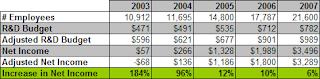
As one of the commentators says

As one of the commentators says
Working conditions at the newspaper are fine: Co-workers are pleasant, the supervisors treat me well, and I believe that both respect me. This means that my total benefits — some I certainly provided to myself — work into the equation to produce the sum total of benefits. I am conscious that I am taking advantage of them and appreciate them. I am currently satisfied with the quality and quantity that makes up the sum total. Perhaps for similar practical and intrinsic reasons, Apple employees are satisfied at Apple.
Tuesday, June 17, 2008
iPhone and price discrimination
The Telegraph looks at the iPhone and emphasises the low price of the latest model. This is another reminder of the way that Apple has successfully managed to satisfy two major segments of the market.
"Apple seems to have realised it needs to drive volumes beyond gadget-happy geeks who would pay enormous amounts to have this piece of gadget bling."
Subscribe to:
Posts (Atom)