There is a lot of information about the financing of the US external deficit. AS part of this is clearly due to financing in low yield reserve currency which is in demand because of its liquidity. However, as Gournichas and Rey show in From World Banker to World Venture Capitalist: US External Adjustment and the Exhorbitant Priveledge this is also about the returns that are achieved on the same assets. US FDI returns are much in excess of the returns that foreigners achieve in the US. HBS Working Knowledge suggest that this is partly because of the tough condtions that exist in the US. There is no low hanging fruit.
Another reason that financing the US deficit may be easier than had been feared is that sovereign wealth funds should probably not be seen as 'smart money'. These, after all, are government departments. Jory, Perry and Hemphill find that SWF investments announcements have not noticable effect on the price of the stock that they have bought and that, in the long run (for what it is worth in these cases) they have under=performed the overall stocks and the financial sector.
Wednesday, July 30, 2008


Tuesday, July 29, 2008
Viscious cycle
Yves Smith looks at the downward momentum that builds as a a firesale of assets leads to additional deterioration of balance sheet of other financial institutions.
NAB and the Australian stockmarkets were directly affected by the Merrills move, which reflects the US banker's desperate desire to quit as much of its toxic subprime mortgage related investments as it can, without regard to the flow on impact to other banks and markets.
In effect Merrill's move to sell these holdings of CDOs to a distressed debt fund investor, forced the NAB to write-down the value of its holding in the CDOs, a move which triggered a huge sell-off of Australian bank shares Friday and yesterday. Yesterday the ANZ revealed a completely unrelated set of write-offs and provisions, butr these had more to do with the slowing Australian economy.
Sunday, July 27, 2008
Behavioural finance
Scientific American looks at at decision-making and the interaction between intuition and reason.
Tuesday, July 22, 2008
Selling Louisiana back to the EU
MacroMan discusses selling Louisiana back to the EU.
The first port of call is to take profit on a number of 18th century transactions conducted by the US Government. Top of the list is the Louisiana Purchase, which was consummated in 1803 for the princely sum of $23,213,568. To derive a current marketable value, Macro Man calculates an annual cash flow by multiplying state GDPs by 18% (the proportion of US nominal GDP that the Federal government receives in tax revenue) and assigns a modest P/E multiple of 8 to the result. Perhaps some banks or Donald Trump would assign a higher multiple to these one-of-a-kind assets, but Macro Man prefers to dwell in the realm of reality.
Monday, July 21, 2008
Dublin
Some comments in the FT about Dublin as a financial center.
Dublin has effectively come from nowhere to become a strong challenger to Luxembourg as Europe’s biggest asset servicing centre. It has done this by becoming the home of choice for many Ucits funds, Europe’s leading domicile for money market funds and the largest administration centre for exchange traded funds in Europe. According to the Global Financial Centre’s Index published by the City of London, Dublin is the world’s 13th best financial centre and 10th for fund management
So how has this been achieved in the 21 years of the IFSC’s existence? A number of positive factors have fuelled Dublin’s growth, notably Ireland’s position as a member of both the European Union and the eurozone, its use of English, the strong supply of well-educated graduates (at least until recently) and the country’s legal framework.
However, regulation and tax were probably more critical to the IFSC’s success than anything. The financial regulator, the Irish Financial Services Regulatory Authority, is seen as combining robustness with responsiveness, and industry players welcome the efficiency of the regulatory approval process. The IFSRA can afford to be accommodating and attuned to innovations partly because of the lack of a significant indigenous fund management sector. Mr Slattery says: “Here in Ireland we understand the benefit of having an appropriately pitched regulatory regime.”
Low taxes have also played a big part in Dublin’s success. From the IFSC’s launch in 1987 until 2004-05, firms based there paid corporation tax at just 10 per cent. Although this has now risen to the standard 12.5 per cent, it still compares favourably with the 28 per cent levied in the UK and the EU average of 33 per cent
Sunday, July 20, 2008
Supply and demand on land prices
FT.com / In depth - US builders forced to sell off holdings: The FT looks at the combined effect of oil and food price increase on the demand for land.
"The result is that farmland close to cities that has often been the seedbed for new housing developments is becoming less valuable to builders, at the same time as farmers want more of it."
Thursday, July 17, 2008
Brad DeLong on Greenspan
Back in the second half of the 1990s, various people went into Alan Greenspan's office. "Raise interest rates!" they said. "Let unemployment go up! The Phillips curve can't have shifted in this far! The natural rate of unemployment can't have fallen so far so fast! These stock market valuations can't be rational! We are headed for a big crash, or a big inflationary spiral--unless you change course now!"Link
Alan Greenspan responded that there was no sign of overly-tight labor demand, no sign of accelerating demand-pull or wage-push inflation that would warrant interest rate increases. People were indeed investing enthusiastically in high-tech start-ups and those buying stocks at outsized price-earnings ratios. But the people doing the buying and investing were relatively well-off, and were grownups. If it turned out to be a serious bubble, and if the unwinding of the bubble triggered a financial panic and threatened to produce a high-unemployment recession, then would be the moment for the Federal Reserve to step in and clean up the mess. In the meanwhile, it would be a shame to destroy millions of jobs and wreck a period of 4%+ economic growth just because the Federal Reserve thought that it knew better than grownup investors what prices they should be paying for stocks and shares in high-tech startups, and feared that there might be trouble in the future.
Similarly, in the middle years of the decade of the 2000s, various people went into Alan Greenspan's office. "Raise interest rates!" they said. "Let unemployment go up! Long-term interest rates cannot stay this low for long! The sustainable pace of construction can't have risen so far so fast! These real estate valuations can't be rational! We are headed for a big crash, or a big inflationary spiral--unless you change course now!"
Alan Greenspan responded that there was no sign of overly-tight labor demand, no sign of accelerating demand-pull or wage-push inflation that would warrant interest rate increases. People were indeed building houses and buying mortgages and taking out home-equity loans enthusiastically at outsized price-rental and mortgage-value income ratios. But the people doing the buying and investing were relatively well-off, and were grownups. If it turned out to be a serious bubble, and if the unwinding of the bubble triggered a financial panic and threatened to produce a high-unemployment recession, then would be the moment for the Federal Reserve to step in and clean up the mess. In the meanwhile, it would be a shame to destroy millions of jobs and wreck a period of 3%+ economic growth just because the Federal Reserve thought that it knew better than grownup investors what prices they should be paying for mortgages and houses, and feared that there might be trouble in the future.
The unwinding of the dot-com bubble in 2000-2002 went remarkably well: no significant macroeconomic distress, and less financial panic and distress than I believed possible. The unwinding of the real estate bubble in 2007-2009 is so far not going well. There is, by contrast, more financial distress than I believed possible. Who thought that quantitatively sophisticated hedge funds would have enormous unhedged exposure to subprime risk? Who would have thought that highly-leveraged investment banks with an originat-and-sell business model would keep lots of the securities they had originated in their own portfolios--and kept them because they were high yield for their rating, i.e., because the market did not believe they were as low risk as the investment banks had bamboozled the ratings agencies into claiming? Who would have thought that those buying subprime mortgage securities from the likes of Countrywide had done no investigation into how Countrywide was screening out borrowers?
But so far--look: In the dot-com boom of the 1990s we were the winners. The rich investors of America built out a huge amount of fiber-optic cables and conducted an enormous amount of experimentation in business models from which we all benefit. In the real-estate boom of 2000s the rich investors of America and the world built an extra four million houses and loaned the rest of us money at remarkably low interest rates for five years. Those who moved into newly-built houses with teaser-rate mortgages wish those teaser rates would continue--but they won't, and in the meantime they got to live in a nice house for quite a low rent. Those of us who took out big home equity loans wish the low interest rates would continue--but they won't. And those of us who felt rich because our house values have appreciated wish we still could think of ourselves as sleeping on a pile of gold--but we can't.
The dot-com bubble and the real-estate bubble were bad news for the investors in Webvan, WorldCom, Countrywide, FNMA, and securitized subprime mortgages. But they were, by and large, good news for the rest of us. And investors are supposed to take care of themselves.
Now we are not yet out of the woods. If the tide of financial distress sweeps the Fed and the Treasury away--if we find ourselves in a financial-meltdown world where unemployment or inflation kisses 10%--then I will unhappily concede, and say that Greenspanism was a mistake. But so far the real economy in which people make stuff and other people buy it has been remarkably well insulated from panic at 57th and Park and on Canary Wharf.
Wednesday, July 16, 2008
Fannie Mae and the limits of public obligation
Fannie Mae and the limits of public obligation:
John Kay looks at the regulation of the financial services industry. Despite his plea, it looks much more likely that it will be the former rather than the latter.
"The problem is that the difference between government powers and government responsibility can be addressed by increasing the powers or reducing the responsibility. We should do the latter."
John Kay looks at the regulation of the financial services industry. Despite his plea, it looks much more likely that it will be the former rather than the latter.
Tuesday, July 15, 2008
The Peso Problem
Alex Tabarrok points us to an overview of the classic Peso Problem
Tabarrok also considers this to be a feature of the spread between GSE bond rates and that of other mortgage-backed securities.
More here.
Milton Friedman stated that the interest differential between the two countries may have been due to the market expecting the peso to be devalued against the US dollar. And sure enough, in 1976, the market expectation actually came true as the peso was allowed to ``float'' against the dollar.
Tabarrok also considers this to be a feature of the spread between GSE bond rates and that of other mortgage-backed securities.
More here.
Tuesday, July 08, 2008
Speculation
There are no onion futures but volatility remains high.
The onion conundrum: no futures market, high volatility - Jun. 27, 2008:
Thanks to Marginal Revolution.
The onion conundrum: no futures market, high volatility - Jun. 27, 2008:
"And yet even with no traders to blame, the volatility in onion prices makes the swings in oil and corn look tame, reinforcing academics' belief that futures trading diminishes extreme price swings. Since 2006, oil prices have risen 100%, and corn is up 300%. But onion prices soared 400% between October 2006 and April 2007, when weather reduced crops, according to the U.S. Department of Agriculture, only to crash 96% by March 2008 on overproduction and then rebound 300% by this past April"
Thanks to Marginal Revolution.
Saturday, June 28, 2008
American imports
From Freakonomics, import genius records all the container imports into the US. Scroll to the bottom of the page to watch imports in real time.
Tuesday, June 24, 2008
Efficient market
Wired in a more general look at data, uncovers a way to make more accurate predictions of crop growth. Here is a small case study in the increased efficiency of information assimilation.
Farmer's Almanac is finally obsolete. Last October, agricultural consultancy Lanworth not only correctly projected that the US Department of Agriculture had overestimated the nation's corn crop, it nailed the margin: roughly 200 million bushels. That's just 1.5 percent fewer kernels but still a significant shortfall for tight markets, causing a 13 percent price hike and jitters in the emerging ethanol industry.
Wednesday, June 18, 2008
Apple and profit
Oren Hurvitz looks at Apple and the effect of paying engineers less than the competition.
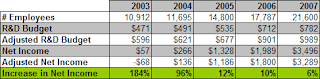
As one of the commentators says

As one of the commentators says
Working conditions at the newspaper are fine: Co-workers are pleasant, the supervisors treat me well, and I believe that both respect me. This means that my total benefits — some I certainly provided to myself — work into the equation to produce the sum total of benefits. I am conscious that I am taking advantage of them and appreciate them. I am currently satisfied with the quality and quantity that makes up the sum total. Perhaps for similar practical and intrinsic reasons, Apple employees are satisfied at Apple.
Tuesday, June 17, 2008
iPhone and price discrimination
The Telegraph looks at the iPhone and emphasises the low price of the latest model. This is another reminder of the way that Apple has successfully managed to satisfy two major segments of the market.
"Apple seems to have realised it needs to drive volumes beyond gadget-happy geeks who would pay enormous amounts to have this piece of gadget bling."
Wednesday, May 28, 2008
How Thinking Costs You
Michael S Rosenwald gives an overview of behavioural bias as he looks at how Thinking Costs You:
"Like most things human, it depends on which one you ask. Odean said he saw two options: Be dumb and let others make money off you, or just buy a no-load index mutual fund and stop focusing on beating the market. Kahneman said there was no one-size-fits-all advice, but he liked the idea of having one sure thing and one long shot. The personal finance planners say investors should stick with them -- they get paid to understand this stuff, and to win. Of course, they are humans too, which means they could be prone to the same problematic behaviors"
Sunday, May 25, 2008
Collective price discrimination
The FT looks at the possible competition case against banks charging for loan protection.
Looks like a case of price discrimination. Those that will stand up to the hard-sale ("what if you lose your job?" etc) will get the cheap loan, others pay up.
One banker said: “Personal loan rates have been uneconomic for a while. Rates are likely to go up if PPI is sold separately.”
Bankers expect the commission to argue in its provisional investigation findings – due to be published early next month – that PPI is uncompetitive because customers typically buy it only from the bank where they took out the loan.
Despite industry lobbying, the commission will stick close to its provisional conclusion this year that banks selling the insurance are earning as much as £1.5bn a year above a reasonable rate of return by selling to buyers who are in effect a captive market.
The market for PPI – which covers loan-holders if they become ill or lose their jobs – is worth about £5.5bn a year. The Office of Fair Trading said last year that banks were loading cheap loans with expensive insurance policies.
One competition lawyer who acts for a bank said the commission had concluded that banks were in effect “getting people through the door, quoting them a very low price [for a loan] then selling them something else”.
Looks like a case of price discrimination. Those that will stand up to the hard-sale ("what if you lose your job?" etc) will get the cheap loan, others pay up.
Friday, May 23, 2008
American Idol
Freakonomics: look at the ways that voting on American Idol can be predicted. There is a lot here about information and the way that it can be used in trading.
"But there are many other ways to predict who would win. TiVo has experimented with using data from 20,000 random anonymous subscribers to find out when viewers fast-forward or re-watch particular contestants. Neat idea, but so far they have had a much lower success rate than DialIdol.Instead of looking at phone and television behavior, you can also try to make predictions from Internet behavior. Apple might look at iTunes downloads of the contestant songs. Or you could use Google Trends to see which contestant name has been searched more often. David Cook rules by this method as well:"
Monday, May 19, 2008
Scarcity of safe assets
Richard Kline looks at the way that the scarcity of safe assets (with US budget surplus and demand for Treasuries from China) contributed to the increased securitisation of debt.
This is one aspect of financial crisis that has not been much remarked upon. If there is scarcity, the price will rise and the financial system will seek to provide an alternative or substitute.
Thus an unheard of budget surplus together with major new Treasury buyers indicated that the asset basis for large-volume transactions in the US was going to contract sharply, putting pressure on top tier banks and bank-like entities to find the next best alternative, and fast. These were . . . securitized GSE instruments. Which as slightly less favorable assets carried slightly more charming rates. It was this experience which in many ways set the feet of large US financials on the slippery slope of asset backed security speculation. Thus an event structurally possible within the US financial system, but of very low probability (hadn't happened since your grandfather was younger than your children are now, and wasn't intended to happen at all), refocused major capital flows at the top of the system. With disastrous near term results as we now see. That the budget surplus appears to have been largely generated by capital gains thrown off by the dot.com equities bubble, and so not sustainable not to say illusory, is secondary since the effect of the surplus on the system as a whole was real at the time.
This is one aspect of financial crisis that has not been much remarked upon. If there is scarcity, the price will rise and the financial system will seek to provide an alternative or substitute.
Saturday, May 17, 2008
China in Africa
Edward Miguel looks at developments in Africa. One part is the increased presence of Chinese firms. He says.
"Why have Chinese individuals and firms dived in when European and U.S. investors have largely shied away? In discussions with Chinese investors, it seems the key motive is simple: profit. Africa provides bountiful profit opportunities across multiple economic sectors for Chinese firms flush with cash from their boundless growth at home. Chinese investors also have a major advantage over their Western counterparts in that they know how to make money in a developing–country business environment where the rule of law is optional, corruption and bribery are the norm, and infrastructure is patchy. Their experiences at home give them a big leg up on the competition."
Creative destruction
Michael Perelman looks at Schumpeter and Stolper.
I did find that one of these economists, David A. Wells, a name well known at Harvard, did clearly anticipate the theory of creative destruction (see Perelman 1995, p. 192). For Wells, the measure of success of an invention is the extent to which it can destroy capital values. He offered as an example “[t]he notable destruction or great impairment in the value of ships consequent upon the opening of the [Suez] Canal” (Wells 1889, p. 30). Wells asserted that each generation of ships becomes obsolete in a decade. From here, he concluded, “nothing marks more clearly the rate of material progress than the rapidity with which that which is old and has been considered wealth is destroyed by the results of new inventions and discoveries” (Ibid., p. 31).
Subscribe to:
Posts (Atom)